Cost of Spare Parts Coverage
The classic car world is a labor of love, isn't it? You pour your heart, soul, and hard-earned cash into that gleaming piece of automotive history, making sure it's perfect. But what about all those precious spare parts? The original carburetors, that elusive trim piece, or even an entire backup engine tucked away in your garage? It’s a common worry among collectors: what if those valuable components are damaged, stolen, or lost? This guide is here to shed light on the often-overlooked cost of spare parts coverage, ensuring your irreplaceable treasures are protected.
Understanding Spare Parts Coverage in Classic Car Insurance
When you invest in a classic car, you quickly realize it's not just the car itself that holds immense value. Often, the parts that keep it running, or those rare components you've meticulously sourced for a future restoration, are just as precious, if not more so. Losing them or having them damaged can be a heartbreaking setback, both emotionally and financially. This is where specialized spare parts coverage steps in, providing a safety net that standard insurance simply can't match.
What Exactly is "Spare Parts Coverage"?
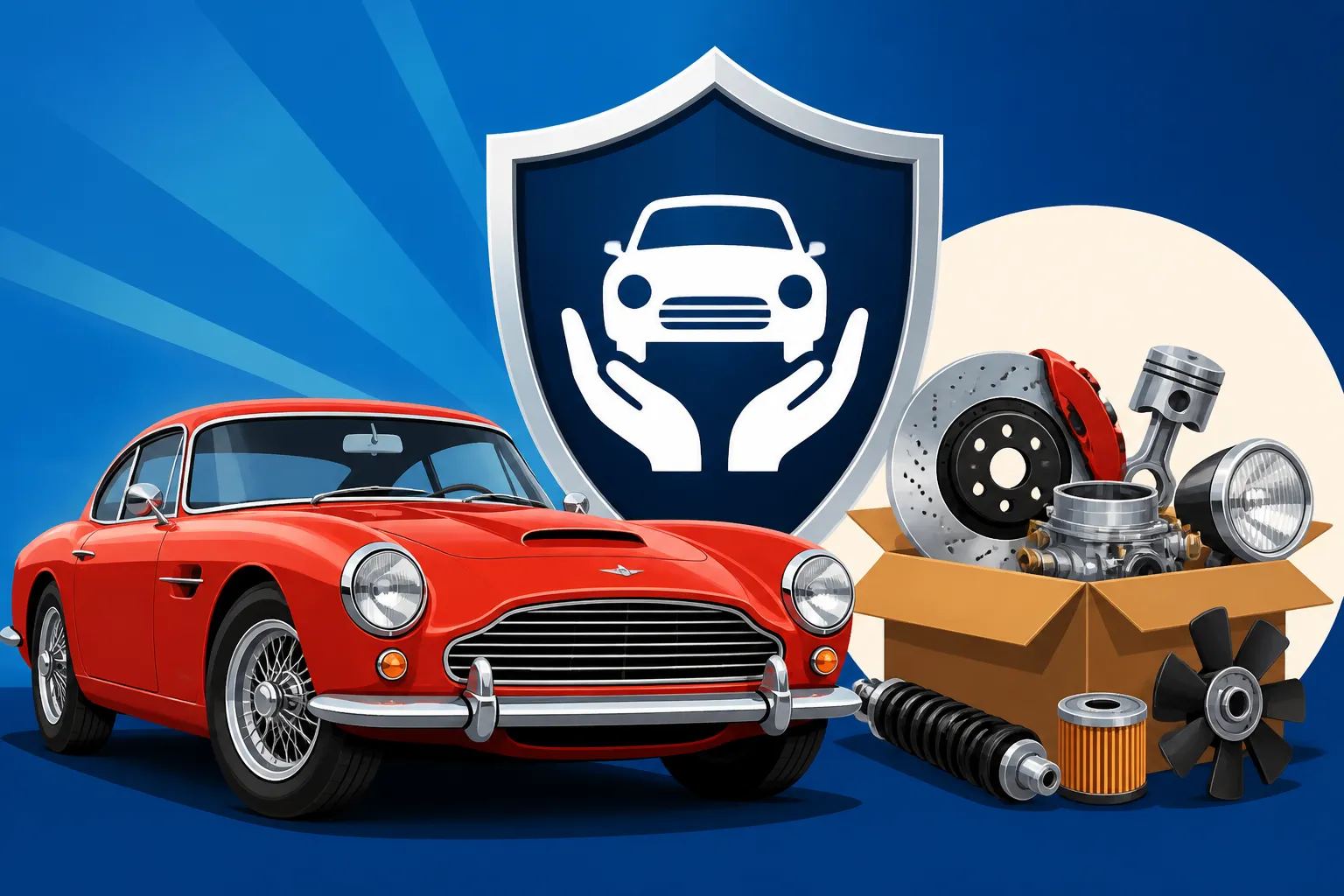
Think of "spare parts coverage" as a dedicated policy extension designed specifically for the unique needs of classic car owners. It's an endorsement or an add-on to your main classic car insurance policy that protects those extra components you own – parts that aren't currently installed on your insured classic vehicle but are intended for it. This isn't just about a couple of old spark plugs; we're talking about significant investments.
This coverage can extend to a wide range of items. For instance, if you have a freshly rebuilt numbers-matching engine waiting for installation in your '69 Camaro, that engine could be covered. The same goes for a rare, original transmission you snagged at an auction, or a stack of new-old-stock (NOS) chrome trim pieces for your vintage Cadillac. Even those hard-to-find dashboard gauges or pristine upholstery kits that you spent years tracking down can fall under this protection. The key is that these parts are typically specific to your classic vehicle or collection and hold a significant value independent of being installed on the car. Without this specialized coverage, should disaster strike, you could be left to absorb the entire loss of these valuable assets yourself.
Why Standard Policies Fall Short for Collectors
Here’s the frustrating truth many classic car owners discover: your everyday auto insurance policy, or even a homeowner's policy, is woefully inadequate for covering classic car spare parts. Standard auto insurance is built around the idea of a modern car and its current market value, often using Actual Cash Value (ACV) after depreciation. This model completely fails to grasp the escalating, often appreciating, value of classic car components. A standard policy might cover a part for pennies on the dollar, or not at all, because it's considered "old" or "used."
Similarly, while your homeowner's insurance might offer some protection for personal property, it usually comes with severe limitations. There are often low caps on high-value items, specific exclusions for vehicle-related parts, and a high deductible that makes filing a claim for anything less than catastrophic loss impractical. You wouldn't insure a Rembrandt for the cost of its canvas and paint, so why would you trust your irreplaceable vintage parts to a policy that sees them as merely old metal? Specialty classic car insurers understand that a rare 1960s carburetor isn't just a "car part"; it's a piece of history with a value often determined by its scarcity and provenance, not its depreciated state. This fundamental difference in valuation is why a specialized approach, often with an Agreed Value for the parts, is absolutely critical.
Factors Influencing the Cost of Spare Parts Coverage
When you're looking at insuring your classic car's spare parts, it's not a one-size-fits-all situation. The cost isn't simply pulled out of thin air; it's meticulously calculated based on several key factors that reflect the risk and the potential payout an insurer might face. Understanding these factors can help you prepare for what to expect and even give you some control over your premiums.
The Value and Rarity of Your Parts Inventory
Undoubtedly, the most significant factor influencing the cost of spare parts coverage is the value and rarity of the items you wish to insure. It makes perfect sense, doesn't it? Insuring a cache of easily replaceable spark plugs is a far cry from insuring a genuine, unrestored 427 V8 engine block, a set of factory-original wire wheels for a Jaguar E-Type, or a meticulously restored period-correct radio.
Insurers will assess the collective "agreed value" of your spare parts. This value is often determined through appraisals, detailed receipts, or market research for similar components. Parts that are New Old Stock (NOS) and still in their original packaging will command a higher valuation than reproduction parts or used items. Extremely rare parts, perhaps from a limited-production vehicle or components that are no longer manufactured, carry a higher risk for the insurer and thus a higher premium. For example, insuring a rare set of 'Cobra' valve covers for a Shelby Mustang would cost more than insuring a common Chevrolet small-block fender, due to the sheer difference in their replacement value and scarcity. The higher the agreed value and the harder the parts are to replace, the more you can expect to pay for their protection.
Storage Conditions and Security Measures
Where and how you store your precious spare parts plays a pivotal role in determining your insurance premium. Insurers are all about mitigating risk, and the environment your parts reside in directly impacts that risk. Is your spare engine sitting on an open pallet in a leaky shed, or is it securely stored on an engine stand in a climate-controlled, locked garage with an alarm system? The answer will dramatically affect your rates.
A secure, enclosed, and preferably locked garage or dedicated workshop is ideal. Features like robust locks, alarm systems, motion-sensor lights, and even video surveillance can signal to an insurer that you're serious about protecting your assets, which can lead to lower premiums. Conversely, parts stored in a carport, an unlocked shed, or even outside are considered high-risk and may not even qualify for coverage, or will incur significantly higher costs if they do. For instance, a dedicated collector might invest in a sophisticated garage setup with specialized shelving, fire suppression, and a monitored alarm. This level of diligence provides peace of mind not only for the owner but also for the insurance provider, such as Hagerty, who typically offers more favorable rates for well-secured collections. You can learn more about specific requirements in our article on Garage Storage Requirement for Classic Cars.
Inventory Management and Documentation
This factor might not seem obvious when thinking about cost, but proper inventory management and thorough documentation are absolutely critical. Imagine trying to make a claim for a rare part without any proof it ever existed or what its value was. It would be a nightmare! Insurers value transparency and verifiable information. When you can provide a detailed list, photographs, and ideally, receipts or professional appraisals for your spare parts, you make their job much easier – and in turn, make your case for favorable rates stronger.
A well-organized inventory, complete with part numbers, condition descriptions, and documented values, tells the insurer that you're a responsible owner. This reduces their administrative burden and the potential for disputes during a claim, which can indirectly translate into better pricing for you. Some collectors even use digital inventory systems or spreadsheets, keeping everything meticulously updated. This diligence, especially for higher-value parts like a period-correct convertible top assembly or an entire drivetrain, proves your valuation is legitimate and helps avoid underinsuring a classic. You’ll find that companies like American Collectors Insurance often appreciate detailed records as it streamlines the underwriting process and can solidify your agreed value.
How Insurers Determine Premiums for Spare Parts
Understanding the 'why' behind the cost is one thing, but knowing the 'how' can empower you to make smarter decisions about your coverage. Insurers employ specific methods and considerations when calculating premiums for spare parts, many of which mirror how they approach insuring the classic vehicle itself.
Agreed Value for Spare Parts
Just like your cherished classic car, the most beneficial way to insure your spare parts is through an "Agreed Value" policy. This is a fundamental difference from standard insurance. With Agreed Value coverage, you and the insurance company agree on a specific dollar amount for your parts inventory before a loss occurs. If those covered parts are later stolen or completely destroyed, the insurer pays out that exact agreed-upon amount, no questions asked, no depreciation applied.
To establish this Agreed Value, insurers will typically require documentation. This might include recent appraisals from reputable classic car part specialists, detailed purchase receipts, or even documentation of recent sales of identical items. For instance, if you've recently purchased a rare 'Coke bottle' intake manifold for your muscle car and have the receipt, that helps establish its value. If you're unsure how to accurately value your spare parts, a professional appraisal can be invaluable, especially for unique or high-value items. This proactive approach ensures that when you need to file a claim, there's no haggling over worth, and you receive the true value of your investment. Our guide on How Agreed Value Is Determined delves deeper into this crucial concept.
Deductibles and Coverage Limits
When getting spare parts coverage, you'll also have choices regarding your deductible and the overall coverage limits, and these choices directly impact your premium. The deductible is the amount of money you agree to pay out-of-pocket before your insurance coverage kicks in. Generally, opting for a higher deductible will lower your annual premium because you're taking on more of the initial financial risk yourself. Conversely, a lower deductible means higher premiums, but less out-of-pocket expense if you ever need to file a claim.
Coverage limits define the maximum amount the insurer will pay for a covered loss to your spare parts inventory. You might have a specific limit per item, or a total aggregate limit for your entire collection of parts. For example, you might choose a $1,000 deductible with a total coverage limit of $25,000 for all your spare parts. If your parts collection is significantly more valuable than that, say $75,000, you'll need to adjust your limits accordingly, which will, of course, increase your premium. It’s crucial to select limits that accurately reflect the total value of your parts to avoid being significantly underinsured, which could lead to substantial losses if a major incident occurs.
Relationship to Your Main Classic Car Policy
Spare parts coverage is almost always offered as an add-on or endorsement to your existing classic car insurance policy. It's rarely a standalone policy. This integration is beneficial because it means you're often dealing with the same specialty insurer who already understands the unique nature of classic vehicles and their components. This streamlined approach can also sometimes lead to multi-policy discounts or simplifies the claims process since all your classic-related assets are under one roof.
Most reputable classic car insurance providers, such as Grundy or Hagerty, offer this kind of additional coverage. They recognize that a true collector's passion extends beyond just the vehicle itself to the pieces that maintain, restore, or enhance it. When you speak with an agent about your main classic car policy, always bring up your spare parts inventory. It's usually a simple process to add this critical protection. By bundling it with your primary policy, you ensure a cohesive insurance strategy that truly protects your entire classic car hobby, from the show-winning vehicle to the smallest, rarest bolt you’ve been safeguarding.
Typical Costs and What to Expect
Let's get down to brass tacks: what's this going to cost you? It’s a valid question, and while I can't give you an exact quote right here (insurance is always tailored to your unique situation!), I can give you a solid idea of the typical cost ranges and how to think about budgeting for this crucial protection.
Average Cost Ranges for Spare Parts Coverage
Generally speaking, spare parts coverage is one of the more affordable additions to a classic car insurance policy, especially when you consider the value it protects. It's often calculated as a small percentage of the total agreed value of your parts inventory or as a tiered flat fee depending on the coverage limit you choose. For many collectors, adding this coverage might range from an extra $50 to $300 per year, depending on the agreed value of the parts.
For instance, if you have a modest collection of spare parts valued at $5,000, you might see an annual premium increase of around $75 to $125. If your parts inventory climbs to, say, $25,000 (think an extra engine, transmission, and a few high-value body panels), your annual cost for spare parts coverage could be in the range of $200 to $400. These are just estimates, of course, and can vary based on your location, storage security, and the specific insurer. The key takeaway is that for a relatively small additional investment, you gain significant peace of mind that your rare and valuable components are protected against unforeseen circumstances.
Comparing Costs Across Specialty Insurers
Just like with your primary classic car insurance, it pays to shop around and compare quotes from various specialty insurers for spare parts coverage. While the core concept is similar, the pricing structure and available limits can differ. Companies like Hagerty, American Collectors Insurance, and Grundy are well-regarded in the collector car space and frequently offer robust spare parts options.
Each insurer has its own underwriting guidelines and risk assessment models. For example, one company might offer a higher maximum limit for spare parts coverage by default, while another might have more stringent documentation requirements but offer a slightly lower rate. Some might offer a blanket coverage amount, while others might ask for itemized lists for higher-value components. It's worth reaching out to several providers to get comparative quotes. Don't just look at the bottom line; compare the coverage limits, deductibles, and any specific exclusions. This due diligence ensures you're not only getting a competitive price but also the most comprehensive protection for your specific needs. Our article on Best Classic Car Insurance Companies can be a great starting point for your research.
Here's a simplified table illustrating potential annual costs for spare parts coverage based on inventory value:
| Total Agreed Value of Parts | Estimated Annual Premium Increase | Example Covered Items |
|---|---|---|
| Up to $5,000 | $75 – $150 | Minor trim, electrical, small engine components |
| $5,001 – $15,000 | $150 – $275 | Transmission, cylinder heads, rare interior parts |
| $15,001 – $30,000 | $275 – $450 | Short block engine, complete differential, NOS body panels |
| $30,001 – $50,000+ | $450 – $700+ | Full engine, rare complete drivetrain, high-value collection of components |
Note: These figures are estimates and can vary based on individual circumstances, insurer, location, and specific policy terms.
Maximizing Value and Minimizing Cost for Your Parts Coverage
Nobody wants to pay more than they have to, especially for insurance. The good news is that by being proactive and diligent, you can often secure the best possible rates for your classic car spare parts coverage while ensuring you're fully protected. It's all about demonstrating to your insurer that you're a responsible owner who takes care of their valuable assets.
Best Practices for Documenting Your Collection
The golden rule for insurance, especially with valuable and unique items like classic car parts, is documentation, documentation, documentation. The more thoroughly you document your parts collection, the smoother the process will be and the better your chances of securing a fair agreed value and a reasonable premium. Start by creating a detailed inventory list that includes:
- Description of each item: Be specific (e.g., "NOS 1967 Mustang 289ci fan shroud, part #C7ZZ-8146-B").
- Condition: New, used, restored, NOS (New Old Stock).
- Estimated value/Agreed Value: Your assessment of its worth, backed by evidence.
- Acquisition date and cost: If you have receipts, keep them!
- Photographs: Clear, high-resolution photos of each item, showing condition and any unique identifying marks.
For particularly high-value items, such as a complete original engine or a rare set of wheels, consider getting a professional appraisal from a specialist who understands the classic car parts market. This third-party valuation adds significant weight to your claim for an agreed value. Having all this information organized and readily available not only simplifies the initial quoting process but also becomes invaluable if you ever need to file a claim. This thoroughness makes a world of difference.
Enhancing Security and Storage
As we discussed earlier, storage conditions directly impact risk, and risk impacts premiums. By investing in robust security and proper storage, you’re not just protecting your parts; you’re also making them more attractive to insurers. Start with a secure, locked garage or dedicated workshop space. This means sturdy doors, high-quality locks, and perhaps even reinforced windows.
Consider adding a monitored alarm system. Even a basic home security system that covers your garage can be a significant deterrent. Motion-sensor lights outside your garage can also deter potential thieves. Beyond security, proper storage also means protecting your parts from environmental damage. Climate control can prevent rust, corrosion, and degradation of rubber or plastic components. Store parts off the floor on sturdy shelving or specialized stands to prevent damage from moisture or pests. For instance, a valuable engine should be on an engine stand, sealed, and perhaps even blanketed. A clean, organized, and secure storage environment reduces the likelihood of loss or damage, which your insurance provider will definitely take into account when setting your rates. This due diligence ensures your collection's longevity and helps keep your premiums in check.
Reviewing and Updating Your Policy Regularly
The classic car market, and by extension the classic parts market, is dynamic. Values can fluctuate, new rare finds emerge, and your collection might grow or change over time. It's a common mistake to "set it and forget it" with insurance policies, but with spare parts, that could leave you seriously underinsured. Therefore, regularly reviewing and updating your spare parts coverage is crucial.
I recommend an annual review, or sooner if you acquire a particularly valuable new part or complete a significant restoration on an existing component. For example, if you bought a complete, original drivetrain for your project car, had it professionally rebuilt, and its value has now doubled, you absolutely need to update your agreed value with your insurer. You can usually do this by contacting your agent and providing updated documentation. This proactive approach ensures that your coverage always reflects the true current value of your parts, protecting your investment and preventing any nasty surprises should you need to file a claim. It’s also a good time to check on your overall policy and perhaps reconsider your Classic Car Insurance Mileage Limits by State if your driving habits have changed.
Common Pitfalls and Important Considerations
Even with the best intentions, collectors can sometimes fall into common traps when it comes to insuring their spare parts. Being aware of these potential pitfalls can save you a lot of headache and heartache down the road, ensuring your prized components are truly protected.
Underinsuring Your Parts Inventory
One of the biggest mistakes collectors make is underinsuring their spare parts. It's easy to underestimate the collective value of a growing pile of components, or to simply opt for a lower coverage limit to save a few dollars on the premium. However, this can be a financially devastating decision. Imagine you have a rare, numbers-matching engine for a 1970 Plymouth Hemi 'Cuda, a part easily worth $40,000-$50,000, but your spare parts coverage limit is only $10,000. If that engine is stolen or destroyed in a garage fire, you'd only receive $10,000 from your insurer, leaving you to absorb a massive $30,000-$40,000 loss out of pocket.
This scenario highlights why Agreed Value is so important and why being diligent with documentation is non-negotiable. Always aim to insure your parts for their full replacement value, especially for those truly irreplaceable or high-dollar items. While it might mean a slightly higher premium, the peace of mind and financial security it provides are well worth the investment. Don't let a small saving now lead to a catastrophic loss later. Our article on How to Prove a Car's Collectible Status can offer guidance on documenting value, which applies to parts as well.
Exclusions to Be Aware Of
Just like any insurance policy, spare parts coverage comes with its own set of exclusions. It’s vital to read your policy carefully or discuss these with your agent to understand what isn't covered. For instance, most policies will not cover general tools or shop equipment, even if they're used exclusively for your classic car. These items typically fall under a separate homeowner's policy, though even there, high-value tools might require additional scheduled coverage.
Similarly, parts for a "daily driver" or modern vehicle are generally not covered under a classic car spare parts policy. The coverage is specifically for components intended for your insured classic or collector vehicle. You might also find exclusions related to how parts are stored – for example, items left unsecured outdoors, or parts for vehicles not listed on your primary policy. Some policies may have specific rules about parts for vehicles currently undergoing restoration; you might need a specialized Restoration Coverage for Classic Cars endorsement instead. Always clarify these points upfront to avoid any unpleasant surprises if you ever need to file a claim.
The Role of an Appraisal for High-Value Parts
For most smaller, more common spare parts, detailed receipts and photographs might suffice to establish an agreed value. However, for genuinely high-value components – think a rare, complete drivetrain assembly, a set of factory competition wheels, or a unique body panel specific to a limited-production model – a professional appraisal is almost always a necessity.
An appraisal from a recognized expert in the classic car field provides an independent, authoritative valuation that insurers will readily accept. This protects both you and the insurance company, ensuring everyone is on the same page regarding the item's worth. An appraiser can account for factors like rarity, condition, originality, and market demand that might be difficult for an untrained eye to quantify. It's an investment that pays off immensely by preventing disputes over value during a claim. If you're insuring an original Shelby Cobra engine or a set of genuine Borrani wire wheels for a Ferrari 250 GTO, trust me, you want that appraisal in hand. It’s an essential step in properly insuring your truly exceptional classic car parts. For more on this, check out our guide on Appraisal Requirements for Classic Car Insurance.
Disclaimer
Please remember that this article provides general information and guidance. Insurance policies and their terms can vary significantly based on the provider, your location, and individual circumstances. It is always crucial to consult directly with a qualified insurance professional to discuss your specific needs, obtain personalized quotes, and thoroughly review the details of any policy before purchasing.