Requirements to Insure a Car Under Restoration
Bringing a beloved classic back to life through restoration is an incredibly rewarding journey, but it also comes with unique challenges, especially when it comes to insurance. Many enthusiasts discover, often too late, that their standard auto policy just doesn't understand the evolving value and specific risks of a car that's in pieces or mid-makeover. This guide will walk you through the essential requirements and specialized coverage options to properly insure your restoration project, ensuring your investment is protected every step of the way.
Why Standard Auto Policies Don't Cut It for Restoration Projects
It's a common misconception that your existing daily driver insurance policy can simply be extended to cover that vintage Mustang or antique truck you're lovingly restoring in the garage. The truth is, standard auto insurance simply isn't designed for the unique circumstances of a project car, and relying on it can leave you severely underinsured or completely unprotected.
The "Actual Cash Value" Trap
One of the biggest pitfalls of relying on a standard policy for a classic car, especially one under restoration, is the "Actual Cash Value" (ACV) clause. Standard insurers typically pay out based on the car's market value at the time of loss, minus depreciation. For a partially disassembled or non-running project, that ACV could be shockingly low. Imagine you've spent thousands on bodywork, paint, and a rebuilt engine for your 1967 Chevrolet Impala, but it's still sitting on jack stands, awaiting interior installation. A standard policy might only value it as a non-operational shell, ignoring all the value you've poured into it. This is a stark contrast to Agreed Value vs Stated Value vs Actual Cash Value offered by specialty insurers, which lock in a predetermined payout.
This means if a fire breaks out in your garage or a theft occurs, you could get a fraction of what you've invested. The frustration of losing your project is bad enough, but realizing your insurance only covers a glorified pile of parts rather than the potential masterpiece it was becoming is a financial nightmare. Specialty classic car insurance understands that the value of your restoration project isn't just about its current state, but also the significant investment of time, money, and rare parts.
Gaps in Standard Comprehensive and Collision
Beyond the valuation problem, standard comprehensive and collision coverages also fall short. These policies are designed for a fully assembled, operational vehicle driving on public roads, not for a car that might be in a disassembled state, stored off-site, or being worked on with specialized tools. Standard policies often don't account for the incremental increase in value as parts are acquired and labor is performed.
For instance, if you've just received a rare, numbers-matching transmission for your vintage Ford Bronco, a standard policy won't have a mechanism to immediately increase your vehicle's insured value to reflect that critical and expensive component. Moreover, they typically don't provide coverage for valuable spare parts, tools, or equipment that are essential to your restoration process but aren't yet installed in the vehicle. This leaves crucial aspects of your restoration unprotected, creating significant financial risk for every step of your project.
Core Eligibility and Documentation for Restoration Car Insurance
Getting proper insurance for a car under restoration isn't as simple as calling your regular agent. Specialty insurers have specific requirements designed to mitigate their risk and ensure that the vehicle truly qualifies for collector status once completed. These requirements often revolve around the car's potential, its current state, and how it will be protected during its transformation.
Demonstrating Collectible Intent
To qualify for restoration coverage, insurers need to see that your project isn't just an old car you're tinkering with, but a genuine collectible in the making. This often means demonstrating that the vehicle, once restored, will meet the criteria for a classic, antique, or vintage car. They'll look at the make, model, year, and its historical significance. For example, a rare, low-production model or a muscle car from the golden era is more likely to be considered a collectible than a common sedan, even if they're both the same age. You'll need to assure them the car won't be a daily driver once completed, which is a key differentiator from regular auto policies.
This intent also extends to the purpose of the restoration. Is it a faithful restoration to original factory specifications? Is it a period-correct hot rod? Or is it a custom build with significant modifications? While many specialty insurers are flexible, understanding your vision helps them properly assess the risk and eventual value. Providing documentation like build sheets, historical photos, or even a detailed restoration plan helps prove your commitment to transforming it into a valuable asset. You might even refer to resources like When a Car Qualifies as Classic to understand the general benchmarks.
Secure Storage and Workshop Environment
One of the most critical requirements for insuring a car under restoration is demonstrating secure storage. Insurers understand that a disassembled vehicle, often with valuable parts lying around, is an attractive target for theft and susceptible to environmental damage. They almost universally require that the vehicle be stored in a fully enclosed, locked, and private garage when not actively being worked on. This isn't just a suggestion; it's usually a non-negotiable condition for obtaining coverage.
Think about it from their perspective: a car parked outside in a driveway, under a carport, or even in a detached shed with poor security is at a much higher risk. Providing details about your garage, including construction type, locking mechanisms, and any alarm systems, can positively influence your eligibility and even your premium. If you're using a professional restoration shop, the insurer will likely want to know about their security protocols as well. For more on this, check out Garage Storage Requirement for Classic Cars.
Detailed Restoration Plan and Valuation
Even when a car is in rough shape, specialty insurers can provide coverage based on its potential and your investment. To do this, you'll need to provide a detailed restoration plan. This isn't just a mental outline; it's a roadmap that includes what work is being done, what parts are being sourced, and an estimated timeline. The clearer your plan, the better an insurer like Hagerty can understand the project's scope and the escalating value.
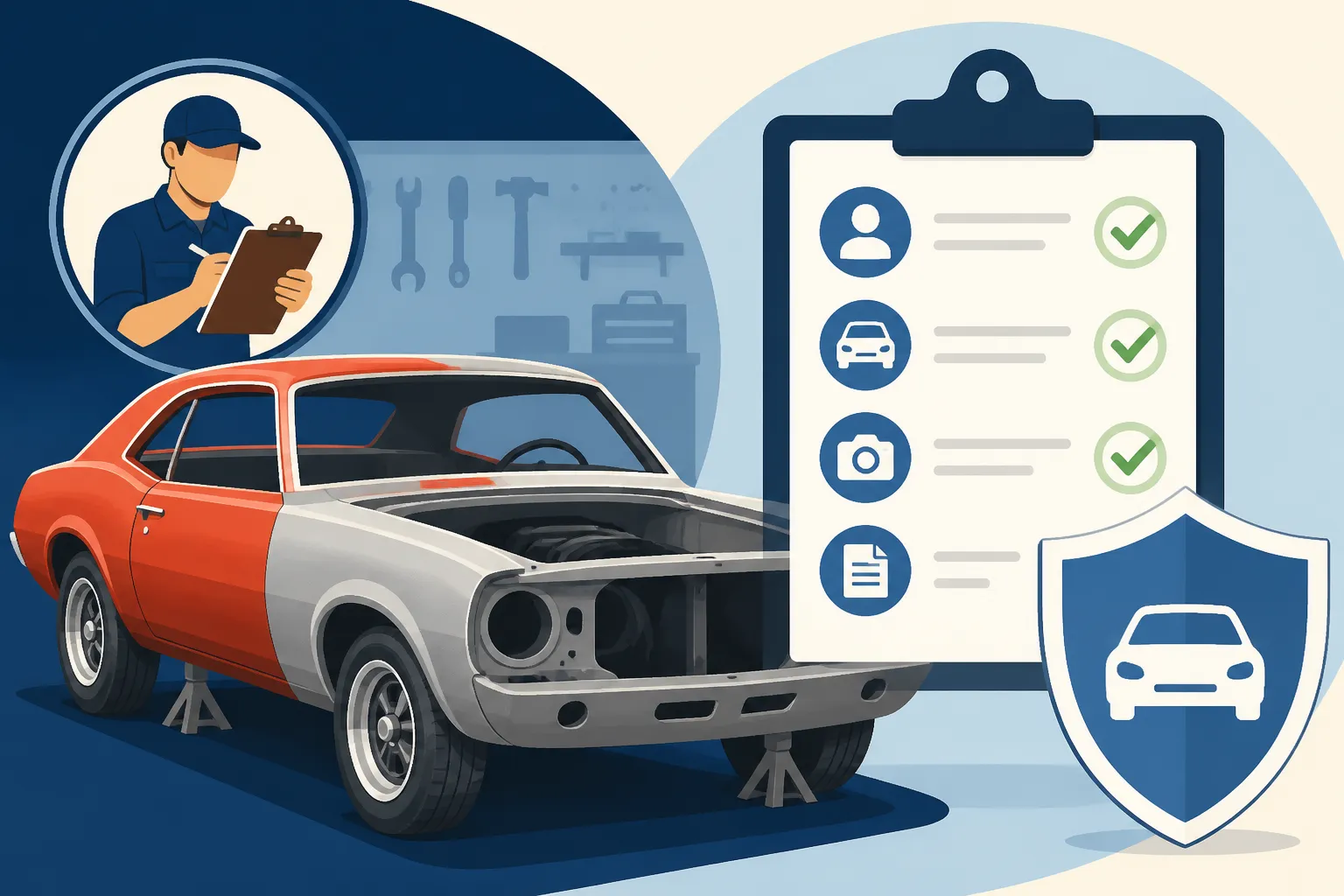
Crucially, you'll need to establish an initial valuation for the car, even in its non-running, project state. This often involves providing photos of its current condition, any existing receipts for parts purchased, and sometimes even a formal Appraisal Requirements for Classic Car Insurance for cars with significant inherent value. As the restoration progresses and you invest more money and labor, you'll need to periodically update your insurer with new receipts and photos so they can adjust the "Agreed Value" of the policy. This iterative process ensures your coverage accurately reflects your growing investment.
Tailored Coverage Options for Your Car Undergoing Restoration
The beauty of specialty classic car insurance is that it offers specific coverages designed precisely for the unique journey of a restoration project. These aren't just minor add-ons; they are fundamental protections that acknowledge the volatile and increasing value of a car in progress.
Vehicle Under Construction (VUC) Coverage
This is perhaps the most vital type of coverage for any car being restored. Vehicle Under Construction Coverage is specifically designed to protect your project car while it's in various stages of disassembly and reassembly. Unlike standard policies that assume a fully functional vehicle, VUC coverage understands that your car might be without an engine, on a rotisserie, or missing its interior. It typically covers perils like fire, theft, vandalism, and accidental damage that could occur while the car is in your garage, at a body shop, or even during transportation between facilities.
Consider a scenario where you've just finished painting the shell of your 1970 Plymouth Barracuda, and while it's drying in the booth, a fire starts due to an electrical malfunction unrelated to your car. Standard comprehensive wouldn't grasp the value, but VUC coverage from a specialty insurer would recognize the significant investment in the fresh paint and bodywork, ensuring you're compensated for that stage of the restoration, not just the pre-restoration value of a rusty shell.
Agreed Value for Progressive Build
For restoration projects, the "Agreed Value" clause is your best friend. This coverage option means you and the insurer agree on a specific value for your vehicle, and in the event of a total loss, that's the amount you'll receive, no questions asked about depreciation. What makes it even better for restoration projects is the ability to progressively increase this agreed value as your project advances. This is a stark contrast to standard policies that might only offer Actual Cash Value (ACV) or Stated Value, which can significantly shortchange you.
Here's how it works: when you start, you might insure your barn find 1955 Ford Thunderbird for $15,000. After you rebuild the engine, re-chrome all the trim, and complete the bodywork, you might have invested an additional $30,000. At this point, you'd contact your insurer, provide the new receipts and updated photos, and request an increase in your Agreed Value to reflect the current investment, perhaps up to $45,000. This ensures that every dollar and hour you pour into your project is protected. You can learn more about How Agreed Value is Determined to ensure you're getting the best protection.
Spare Parts and Tools Coverage
Any serious restorer knows that spare parts and specialized tools are often just as valuable, if not more, than the car itself, especially when dealing with rare or obscure vehicles. Many specialty policies offer specific endorsements or built-in coverage for Spare Parts Coverage Explained and even tools and equipment related to your restoration. This covers those precious NOS (New Old Stock) parts waiting to be installed, extra engines or transmissions, and your collection of specialized wrenches, welders, or paint guns.
Imagine you've just sourced a correct carburetor for your 1969 Camaro Z/28, a part that might cost thousands. If it's stolen from your garage before you install it, a standard homeowner's policy might cover it as general property, but often with limits that won't touch its true value, or with a high deductible. Specialty classic car insurance understands the unique value of these components and provides coverage that reflects their actual replacement cost, offering peace of mind that your investment in parts is just as secure as the car itself.
Here's a quick comparison of standard vs. specialty insurance for a car under restoration:
| Feature | Standard Auto Insurance | Specialty Classic Car Insurance (Restoration Coverage) |
|---|---|---|
| Valuation Method | Actual Cash Value (ACV) – depreciated market value | Agreed Value – predetermined, fixed payout |
| Value Progression | Static or depreciates | Can be increased as restoration progresses |
| Vehicle State Covered | Fully assembled, operational vehicle | Disassembled, in-progress, non-running projects |
| Spare Parts Coverage | Usually none, or limited homeowner's coverage | Dedicated coverage for parts, often high limits |
| Tools/Equipment Coverage | Usually none, or limited homeowner's coverage | Often includes specialized tools and equipment |
| Storage Requirements | Flexible (street, driveway, garage) | Typically requires secure, enclosed garage storage |
| Usage Restrictions | None (daily driver assumed) | Pleasure use only; no daily driving during or after restoration |
| Premiums | Higher due to perceived risk of "old car" | Often lower due to limited usage and secure storage |
Maximizing Protection and Navigating Claims for Your Project Car
Insuring your classic car under restoration isn't a "set it and forget it" process. To truly maximize your protection and ensure a smooth claims experience should the unthinkable happen, proactive management and clear communication with your insurer are absolutely essential.
Keeping Meticulous Records
This cannot be stressed enough: documentation is your best friend when restoring a car, especially for insurance purposes. Every single receipt for parts purchased, every invoice for professional labor, detailed photos before, during, and after each stage of restoration, and a comprehensive log of your own hours and tasks performed. This meticulous record-keeping serves as irrefutable proof of your investment and the increasing value of your vehicle.
Imagine a scenario where your freshly painted frame, engine, and drivetrain for a 1966 Shelby GT350 are stolen. Without clear documentation of the purchase costs for the rare components, the labor involved in rebuilding the engine, and photographs showing their condition, proving their true value to an adjuster would be incredibly difficult. Keep both digital and physical copies of everything. Cloud storage, external hard drives, and a fireproof safe for physical documents are all excellent strategies to protect your records. This level of detail is critical for supporting the Cost of Adding Restoration Coverage and ensuring you're fairly compensated.
Communicating Value Changes with Your Insurer
As your restoration progresses, the value of your vehicle changes dramatically. You start with a bare shell, then add a rebuilt engine, new suspension, pristine bodywork, and a fresh paint job. Each of these stages represents a significant increase in your investment. Specialty insurers like Hagerty are set up to handle this dynamic valuation, but it's your responsibility to keep them informed.
Establish a routine for updating your policy. Perhaps every quarter, or after completing a major component like the engine, transmission, or body and paint, gather your new receipts and photos and contact your agent. They will adjust your Agreed Value accordingly. Failing to do so means you're underinsuring your project. If you've spent an additional $10,000 on a new interior but haven't updated your policy, and then a fire occurs, that $10,000 could be lost. Regular communication ensures your policy always reflects your current investment. More insights can be found in How to Update Coverage After Restoration.
Understanding the Claims Process
Should you unfortunately need to file a claim for damage or loss to your car under restoration, understanding the process beforehand can save a lot of stress. Because you have an Agreed Value policy, the claims process is generally much smoother than with a standard policy. The agreed-upon amount means there's no haggling over depreciation or market value; the payout for a total loss is simply the agreed value you last updated.
However, for partial losses (e.g., specific parts stolen or localized damage), your meticulous records become invaluable. The insurer will want to see proof of the value of the damaged or stolen components and the cost of repairs. For example, if a heavy tool falls and dents your newly installed fender, your documentation helps prove the cost of repair or replacement. Working with a reputable specialty insurer, known for their understanding of classics, can make a huge difference. Companies like Hagerty often have adjusters who are enthusiasts themselves, making the process more empathetic and efficient for complex restoration claims. Remember that even though it's a project, your policy is there to protect it fully.
Disclaimer
Please remember that insurance policies and requirements can vary significantly based on your specific location, the insurer, and the unique characteristics of your vehicle. This guide provides general information and recommendations. Always consult directly with a qualified insurance professional specializing in classic and collector car insurance to discuss your individual needs and to obtain precise, up-to-date policy details and requirements.