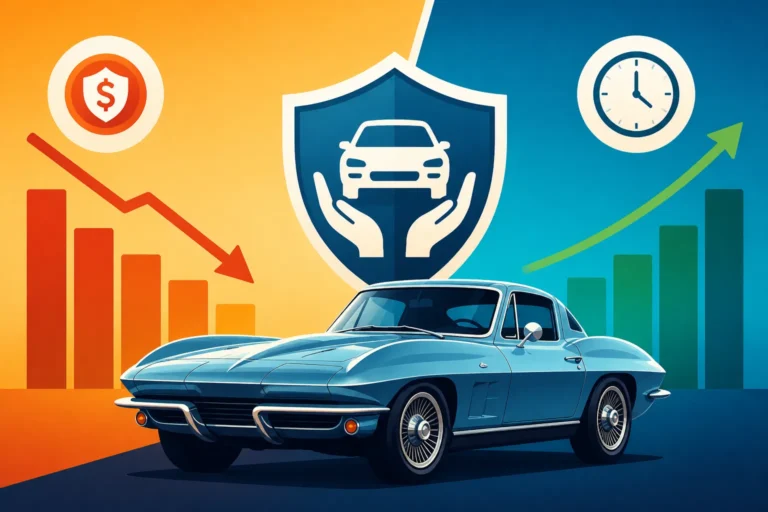
How Vehicle Value Affects Premiums
It can feel like a guessing game trying to figure out how much insurance is going to cost for your prized classic car, and one of the biggest head-scratchers is how its actual dollar value impacts that premium. It’s not like insuring a modern daily driver where depreciation is the norm; our classics often appreciate, and ensuring you’re covered correctly without overpaying or, worse, being underinsured, is a constant worry. This guide will meticulously break down exactly how your classic vehicle's value plays a starring role in shaping your insurance premiums.
The Core Principle: Agreed Value and Your Premium
When you're dealing with classic cars, the whole insurance game changes. Unlike standard car insurance where the payout is often based on "actual cash value" (ACV), which is what your car was worth minus depreciation at the time of loss, classic car insurance operates on a much more collector-friendly principle: Agreed Value. This is the cornerstone of how your car's worth affects your premiums.
Understanding Agreed Value in Detail
Agreed Value is a beautiful concept for classic car owners. It means that you, the owner, and your insurance company agree on a specific dollar amount for your vehicle before the policy is even issued. Should a total loss occur, that's the amount you'll be paid out, no haggling, no depreciation deductions. This fixed value provides immense peace of mind because you know exactly what your investment is worth, in the eyes of your insurer, from day one.
Imagine you have a beautifully restored 1967 Ford Mustang that you and your insurer, let's say a specialist like Hagerty, agree is worth $75,000. If that Mustang is tragically totaled in a garage fire, you'll receive a check for $75,000 (minus your deductible), irrespective of what a typical "market value" might fluctuate to in the moment. This eliminates the devastating surprise of being offered a fraction of what you believe your classic is worth. It’s this predetermined, non-depreciating value that forms the direct basis for your premium calculations. If you're looking for a deeper dive, understanding what Agreed Value Coverage Explained truly entails can save you a lot of heartache.
How Agreed Value Differs from Other Valuations
It’s crucial to understand that Agreed Value isn’t the only way a car can be valued, but it’s by far the most beneficial for classics. Let’s briefly look at the others to highlight the difference:
- Actual Cash Value (ACV): As mentioned, this is common for daily drivers. It’s the replacement cost minus depreciation. For a classic, this would be a disaster, as many classics appreciate or hold their value, and depreciation simply doesn’t apply in the traditional sense.
- Stated Value: This one sounds similar to Agreed Value but carries a significant trap. With Stated Value, you state the value you believe your car is worth. However, in the event of a total loss, the insurance company will only pay out the lesser of the stated value, the actual cash value, or the cost to repair. This means they can still factor in depreciation or market fluctuations, potentially leaving you far short of what you expected. It effectively gives the insurer an "out" to pay you less, making it a less secure option for a truly valuable classic.
For collectors, Agreed Value is the gold standard because it guarantees the payout amount, providing financial security against the unique risks associated with owning a prized vehicle. This is why when you're comparing policies, you really want to ensure you're getting robust Agreed Value Coverage for Classic Cars Explained rather than a lesser form of valuation.
The Direct Correlation with Premiums
Here's the simple truth: the higher your classic car's Agreed Value, the higher your insurance premium will generally be. Why? Because the insurance company is taking on a greater financial risk. If they're guaranteeing to pay you $100,000 for a rare vintage Porsche 911 in the event of a total loss, that's a much larger potential payout for them than if they were only guaranteeing $30,000 for a well-maintained but more common Chevrolet C10 pickup.
The premium you pay is essentially the cost of transferring that risk to the insurer. They use actuarial data, claims history, and a myriad of other factors to determine how much to charge for assuming that potential liability. So, while other factors like mileage limits, storage, and your driving record definitely play a part, the Agreed Value is often the most significant driver of the base premium because it directly dictates the maximum payout in a total loss scenario. This direct link between value and cost is a key part of understanding How Agreed Value Affects Premiums.
Factors Influencing a Classic's Value and thus its Premium
It's not just a number pulled out of thin air. The Agreed Value for your classic car is determined by a complex interplay of factors that speak to its intrinsic worth, its place in automotive history, and its current condition. Understanding these elements is crucial not only for getting a fair valuation but also for knowing how to potentially influence your premium.
Rarity, Desirability, and Historical Significance
Let's be honest, some classics are just more special than others. The fewer of a particular model that were produced, the higher its rarity, and typically, the higher its value. A limited-production muscle car from the 1960s, like a Hemi 'Cuda or a Shelby GT500, will naturally command a higher Agreed Value—and thus a higher premium—than a mass-produced sedan from the same era.
Desirability also plays a massive role. Some cars simply have an "it" factor, driven by pop culture, racing provenance, or iconic design. Think of a 1957 Chevrolet Bel Air versus a 1957 Chevrolet 150. While both are vintage, the Bel Air's iconic status makes it far more sought after and valuable. Historical significance, such as a car that won a major race or was owned by a celebrity, can also dramatically increase its value. These intangible elements translate directly into a higher Agreed Value and, consequently, a higher premium, because their loss would be irreplaceable from both a financial and historical perspective.
Condition, Restoration Quality, and Originality
Beyond rarity, the actual physical state of your classic is paramount. A car in pristine, concours-level condition, whether original or meticulously restored, will always have a higher Agreed Value than a similar model that's a "driver quality" car or a project needing significant work.
- Condition: We're talking about everything from the paint and bodywork to the interior, engine bay, and undercarriage. Is it free of rust? Does everything function as it should? A car that looks like it just rolled off the showroom floor, or has been maintained impeccably for decades, signifies a higher investment and care, warranting a higher valuation.
- Restoration Quality: If your car has been restored, the quality of that restoration is paramount. Was it a budget job, or was every nut and bolt addressed with period-correct parts and expert craftsmanship? A professional, documented, frame-off restoration using NOS (New Old Stock) or factory-correct components will significantly boost value. This is why covering the costs of a rebuild through Restoration Coverage for Classic Cars is so important.
- Originality: For many collectors, especially those interested in purist classes at car shows, originality is key. A car that retains its original engine, transmission, and other major components (often referred to as "numbers matching") is often more valuable than one with replacement parts, even if those replacements are correct. That said, there are also strong markets for expertly restored or modified vehicles that prioritize condition and quality over strict originality.
Modifications and Their Impact on Value
This is where things can get a bit nuanced. Not all modifications are created equal when it comes to classic car insurance.
- Period-Correct Modifications: Certain modifications, especially those popular in the era the car was new, can sometimes enhance value. Think of a muscle car with a period-correct supercharger or a hot rod with historically accurate custom work. These often add to the car's desirability and can be factored into a higher Agreed Value.
- Restomods and Custom Builds: The "restomod" trend, where a classic car's aesthetics are retained but modern components (engine, suspension, brakes, air conditioning) are swapped in for improved performance and comfort, is incredibly popular. These cars often have significant value due to the labor and high-quality parts involved. Insurers like Hagerty are well-versed in covering these highly customized vehicles and understanding the value of bespoke work. If you're building one, you'll want to ensure you have clear Requirements for Insuring a Restomod in place.
- Detracting Modifications: On the flip side, poorly executed modifications, non-period correct changes that don't enhance performance, or alterations that damage the original character of the car can actually decrease its value. An insurer might not factor these into a higher Agreed Value, or might even require them to be reversed to qualify for a preferred policy. It really depends on the specific modification and the current market's perception of it.
The Valuation Process: Documenting Your Car's Worth
Getting the right Agreed Value for your classic isn't always straightforward, especially if it's unique or has undergone significant work. Insurance companies need verifiable proof of its worth, and as the owner, it's your responsibility to provide that documentation. This process is crucial because it directly underpins the premium you'll pay and the payout you'll receive if disaster strikes.
The Role of Professional Appraisals
For many classic car owners, especially those with higher-value vehicles or unique custom builds, a professional appraisal is an indispensable tool. A certified appraiser, specializing in collector cars, will conduct a thorough examination of your vehicle, taking into account its condition, originality, restoration quality, rarity, market desirability, and historical significance. They will compare it to recent sales of similar vehicles and provide a detailed, unbiased report outlining its fair market value.
This appraisal report serves as concrete evidence for your insurance company, helping to justify the Agreed Value you are seeking. It takes the guesswork out of the equation and provides a strong foundation for your policy. While not all insurers or all vehicles require an appraisal, particularly for cars in the lower value tiers, it's highly recommended for significant investments. Knowing How to Get a Classic Car Appraisal can make this step much smoother.
Maintaining Comprehensive Records
Even without a formal appraisal, or to bolster an appraisal, maintaining meticulous records of your classic car is paramount. These records are your story, your proof of investment, and your argument for its value. What kind of records are we talking about?
- Purchase Records: Original bill of sale, previous titles, any documentation from prior owners.
- Restoration Documentation: Receipts for parts (especially if NOS or rare), invoices from reputable restoration shops, photographs of the restoration process (before, during, and after), and lists of work performed. This is particularly important for tracking the rising value of your car during a project, and many insurers will want to see this if you have Restoration Coverage for Classic Cars.
- Maintenance History: Records of routine maintenance, repairs, and upgrades, especially if performed by specialists.
- Modifications: Documentation of any modifications, including parts used, who performed the work, and why.
- Awards and Show History: Certificates or trophies from car shows, concourse events, or rallies.
- Photographs: High-quality, detailed photographs of the car from every angle, including the engine bay, interior, trunk, and undercarriage, taken regularly to document its condition over time.
- Valuation Guides and Market Research: Keep an eye on reputable classic car valuation guides (like Hagerty’s Valuation Tool or NADA Classic Car Guides) and auction results for similar vehicles. This demonstrates your awareness of its market position.
These records paint a comprehensive picture of your car's journey and value, aiding the insurer in setting an accurate Agreed Value and, by extension, your premium.
Working with Your Insurer on Valuation
Don't treat the valuation process as an adversarial negotiation. Your classic car insurer, especially a specialist like Hagerty or Grundy, wants to get it right as much as you do. They understand the nuances of the collector car market far better than a standard auto insurer.
When you're getting a quote or renewing your policy, be prepared to discuss your car's specific attributes. Share your documentation, highlight any recent improvements, and explain what makes your car special. They might have their own valuation tools, a network of appraisers, or an in-house team that can help determine a fair Agreed Value. Some insurers might even offer How to Value Your Classic Car for Insurance guidance. Be honest and thorough. A transparent relationship with your insurer ensures that your car is properly covered, and that you're paying a premium that accurately reflects that coverage.
How Specific Value Tiers Impact Rates
The classic car market is incredibly diverse, encompassing everything from entry-level enthusiast cars to multi-million-dollar exotic machines. Naturally, the way vehicle value affects premiums isn't a one-size-fits-all scenario. Different value tiers come with different risks for insurers and, consequently, different premium structures.
Lower-Value Classics: Practical Considerations
When we talk about "lower-value classics," we're generally referring to vehicles with an Agreed Value ranging from, say, $10,000 to $30,000. These might be well-maintained but more common models, or perhaps entry-level collectibles.
For these cars, premiums are often surprisingly affordable, sometimes even cheaper than insuring a modern daily driver, because of the specialized nature of classic car policies. Insurers assume these cars are driven less, garaged securely, and their owners are generally meticulous and responsible. However, even within this tier, value still dictates a significant portion of the premium. A $30,000 classic will cost more to insure than a $10,000 classic, simply because the potential payout in case of a total loss is higher.
The good news for owners of these cars is that some insurers might not even require a formal appraisal. They may be able to determine the Agreed Value based on photos and your descriptive details, drawing from their extensive databases of similar sales. This ease of valuation can streamline the process, making classic car ownership accessible and affordable for new collectors. If you’re just starting out, check out articles on Classic Car Insurance Cost for a First Collector Car.
Mid-Range Collectibles: Balancing Cost and Coverage
This tier typically includes classics valued from $30,000 up to $100,000. Here, you'll find a wide array of desirable muscle cars, well-restored European sports cars, and increasingly, sought-after '80s and '90s "youngtimers."
For mid-range collectibles, the direct correlation between value and premium becomes even more evident. The difference in premium between a $50,000 car and a $75,000 car from the same year and model can be substantial. Insurers will often require a more robust valuation process here, possibly asking for a professional appraisal or detailed restoration documentation to accurately establish the Agreed Value. This ensures that in the event of a claim, the payout truly reflects the significant investment made in the vehicle. For a deeper dive into these costs, you might explore Classic Car Insurance Cost for a $50,000 Vehicle or Classic Car Insurance Cost for a $75,000 Vehicle.
Owners in this category need to be diligent about updating their Agreed Value, especially if they've performed significant upgrades or if market trends show their car appreciating rapidly. The balance here is ensuring you're fully covered for your investment without paying an excessive premium for an outdated valuation.
High-Value and Exotic Classics: Specialized Needs
When you enter the realm of high-value and exotic classics—vehicles valued at $100,000, $250,000, $500,000, and even into the millions—the insurance landscape shifts again. These cars often represent a significant portion of an owner's net worth, and their protection becomes paramount.
Premiums for these vehicles will, understandably, be higher due to the sheer financial risk involved. However, specialist insurers are incredibly adept at assessing these cars. They have dedicated teams for high-value appraisals and understand the intricate nuances of provenance, rarity, and specific market demand for vehicles like a Ferrari 250 GTO or a pristine Duesenberg. For instance, Hagerty Classic Car Insurance Review often highlights their expertise in handling such high-value assets.
For these top-tier classics, the valuation process is usually very rigorous, involving multiple appraisals, in-depth historical research, and often the insurer's own expert valuation staff. Coverage for these vehicles often includes additional endorsements like Inflation Guard Coverage Explained, which automatically adjusts the Agreed Value annually to account for market appreciation, ensuring your policy keeps pace with your car's rising worth. Given the significant investment, exploring articles such as Classic Car Insurance for High-Value Collections Cost is a must. The aim is not just to insure, but to protect a legacy.
Here's a simplified table illustrating how vehicle value generally affects classic car insurance considerations:
| Vehicle Value Tier | Agreed Value Range | Typical Valuation Method | Premium Impact (Relative) | Key Coverage Considerations |
|---|---|---|---|---|
| Entry-Level Classic | Up to $30,000 | Photos, owner description, insurer databases | Low to Moderate | Standard Agreed Value, basic roadside assistance |
| Mid-Range Collectible | $30,001 – $100,000 | Photos, detailed records, often professional appraisal | Moderate to High | Agreed Value, restoration coverage, spare parts coverage |
| High-Value/Exotic | Over $100,000 | Professional appraisal (required), extensive documentation | Significantly High | Agreed Value, Inflation Guard, touring/rally coverage, higher limits |
Managing Your Premium as Value Changes
The value of a classic car isn't static; it can fluctuate due to market trends, a meticulous restoration, or even just the passage of time increasing its rarity. Understanding how to manage these value changes in relation to your insurance policy is key to ensuring continuous, appropriate coverage without overpaying or finding yourself underinsured.
Adjusting Agreed Value for Appreciation or Restoration
One of the greatest joys (and sometimes anxieties) of classic car ownership is watching your vehicle's value appreciate. Unlike a new car that plummets in value the moment you drive it off the lot, many classics steadily gain worth. If your 1969 Camaro, which you insured for $60,000 five years ago, is now worth $80,000 due to market appreciation or a fantastic restoration project you just completed, you must update its Agreed Value with your insurer.
Failing to do so means that in the event of a total loss, you'd only receive the old $60,000 figure, leaving you $20,000 short of its true worth. Conversely, if you perform a high-quality restoration, every dollar spent on parts and labor increases its intrinsic value. Providing receipts, before-and-after photos, and possibly a new appraisal to your insurer will allow them to update the Agreed Value, reflecting your increased investment. Of course, this adjustment will likely lead to a higher premium, but it's a necessary cost to protect your investment adequately. Many policies even offer Inflation Guard Coverage Explained as an endorsement to help with gradual appreciation. This automatic adjustment can be a lifesaver in a rising market.
Discounts and Strategies for High-Value Cars
While higher-value cars naturally come with higher premiums, there are strategies and discounts available that can help mitigate costs, especially when working with specialist insurers.
- Security Features: Installing advanced anti-theft systems, GPS trackers, or even just keeping your car in a secure, alarmed garage can often qualify you for discounts. Insurers know that a well-protected vehicle is less likely to be stolen or vandalized.
- Limited Mileage Programs: If your high-value classic is truly a show car or a weekend cruiser, opting for a lower annual mileage limit (e.g., 1,000 or 2,500 miles per year) can significantly reduce your premium. The less it's on the road, the lower the risk of an accident.
- Multi-Car Policies: If you own a collection of classics, consolidating them under a single multi-car collector policy can often result in discounts compared to insuring each vehicle separately. Insurers like Hagerty often specialize in these types of policies.
- Driver Profile: Maintaining a clean driving record and having significant experience with classic cars can also positively influence your rates. For a comprehensive overview of how classic car insurance costs are calculated, check out Classic Car Insurance Cost: Complete Breakdown.
- Car Club Membership: Belonging to recognized classic car clubs or organizations can sometimes offer small discounts, as these memberships often indicate a dedicated and responsible owner.
The Pitfalls of Underinsuring or Overinsuring
Navigating classic car insurance means striking a delicate balance.
- Underinsuring: This is the most dangerous pitfall. If your classic car is worth $100,000 but you've only insured it for $70,000, you're essentially self-insuring for that $30,000 gap. In a total loss, you'll be significantly out of pocket. It’s a common mistake, especially as cars appreciate, and it’s why regular reviews of your Agreed Value are crucial. Always ensure your policy reflects the current market value of your vehicle. Don't compromise your investment just to save a few dollars on the premium.
- Overinsuring: While less common and less catastrophic than underinsuring, paying premiums for an Agreed Value that is significantly higher than your car's actual market worth is simply wasting money. Insurance companies won't pay out more than the demonstrable value of the car, even if you’ve been paying premiums for a higher amount. So, if your car is actually worth $50,000 but you've insisted on insuring it for $70,000 without proper justification, you're just paying for coverage you'll never receive. While you want full protection, you also want efficient protection.
Regularly review your policy, especially if you've made significant changes to the car or if the market for your specific model has seen big shifts. Knowing How to Update Coverage After Restoration or How to Increase Agreed Value at Renewal can help you stay on top of your policy and ensure optimal coverage.
Beyond Value: Other Premium Influencers
While your classic car's value is a major player in determining your insurance premium, it's certainly not the only factor. A combination of how you store, use, and even who drives your classic car also heavily influences the final cost. These factors often work in tandem with the Agreed Value to create your unique premium.
Storage and Usage Limitations
Classic car insurance isn't just cheaper than regular insurance; it's often more tailored because classic cars are typically treated differently than daily drivers. This unique usage and storage directly impact risk and, consequently, your premium.
- Secure Storage: Insurers love seeing your classic tucked away safely. Most policies require your classic car to be stored in a locked, secure garage, preferably one that is fully enclosed. Storing it in a carport, under a tarp, or, heaven forbid, on the street, significantly increases the risk of theft, vandalism, or damage from the elements, and can lead to higher premiums or even disqualification from a specialty policy. The more secure the storage, the lower the risk, and often, the lower your premium. You can find more details on Garage Storage Requirement for Classic Cars.
- Limited Usage: Unlike your modern SUV that ferries kids to school and commutes to work, classic cars are generally used for pleasure driving, car shows, and club events. They're not primary transportation. This limited use translates to less time on the road, lower exposure to accidents, and thus, lower premiums. Most classic policies come with mileage limitations (e.g., 2,500 or 5,000 miles per year). If you need more flexibility, some providers offer Unlimited Mileage Classic Car Insurance Explained, but expect a higher premium for that added freedom.
- Pleasure-Use Requirement: This isn't just about mileage; it's about how you use the car. It cannot be your primary daily driver. If you're using it to commute to work every day, it won't qualify for a classic car policy. This strict "pleasure-use" or "limited-use" definition is a fundamental reason Why Classic Car Insurance Is Cheaper Than Regular. If you're curious, exploring the Pleasure-Use Requirement Explained can give you a clearer picture.
Driver Profile and Location
Even with a perfectly valued, securely stored classic, the person behind the wheel and where that wheel is turning play a role in the premium.
- Driver's Record: Just like with any auto insurance, your driving history matters. A clean driving record with no accidents or major violations will always result in lower premiums. Conversely, a history of claims or traffic infractions can increase your classic car insurance cost, even if you're only driving it a few times a year.
- Age and Experience: Younger drivers, statistically, are considered higher risk. While some specialty insurers will cover younger collectors, there might be specific Minimum Age for Classic Car Insurance Drivers requirements or higher premiums for those under 25, for instance. More experienced drivers with a long history of safe driving often enjoy better rates.
- Location: Where you live and where your car is primarily garaged also impacts your premium. Urban areas with higher traffic density, greater crime rates, or areas prone to severe weather (like coastal regions susceptible to hurricanes or hail belts) typically have higher insurance costs due to increased risk. Conversely, a classic car garaged in a quiet, low-crime rural area might see more favorable rates.
- Other Household Drivers: If other licensed drivers in your household have access to the classic car, they might need to be listed on your policy. Their driving records and ages can also influence the overall premium. This is why understanding Household Driver Requirements Explained is important for comprehensive coverage.
Ultimately, classic car insurance is designed to protect a valuable asset that is cherished, well-maintained, and used sparingly for enjoyment. The premium reflects not only the agreed value of that asset but also the commitment of the owner to preserving it and driving it responsibly.
Disclaimer
Please remember that this article is intended for informational purposes only and should not be construed as professional financial, insurance, or legal advice. Insurance policies vary widely based on the provider, specific vehicle, and individual circumstances. It is always recommended to consult with a qualified insurance professional to discuss your specific needs and obtain personalized quotes and advice for your classic car.