How Spare Parts Coverage Works for Collectors
It's a familiar scenario for any classic car enthusiast: you've spent countless hours, not to mention a significant chunk of your hard-earned money, tracking down that elusive New Old Stock (NOS) carburetor, a perfect period-correct trim piece, or an engine block destined for a full rebuild. These parts are often as valuable, if not more so, than many components on a daily driver. Yet, when you look at standard insurance, you quickly realize these treasures are often left woefully unprotected. This guide will delve deep into how specialized spare parts coverage works for collectors, ensuring your investment in these critical components is properly safeguarded.
The Unique Value and Vulnerability of Classic Car Spare Parts
For collectors, a car is more than just transportation; it's a rolling piece of history, and every part contributes to its story and value. But unlike modern vehicles where parts are often mass-produced and readily available, classic car components can be exceedingly rare, expensive, and difficult to replace.
Why Standard Auto Policies Fall Short for Collectors' Parts
Most standard auto insurance policies are designed for modern vehicles and don't factor in the unique needs of classic car owners, especially when it comes to spare parts. They typically operate on an "actual cash value" (ACV) basis for parts not installed on the vehicle, meaning they'd pay out the depreciated value. Imagine you bought a rare, original chrome bumper for your '69 Camaro, paying $2,000 for it after a long search. Under a standard policy, if it's stolen from your garage, that $2,000 bumper, even if still in its box, might only be valued at a fraction of its replacement cost due to "depreciation," leaving you completely in the lurch. This approach simply doesn't make sense for parts that often appreciate in value or are irreplaceable.
Furthermore, your regular homeowner's insurance policy, while it covers contents in your garage, often has very low sub-limits for specific categories like "automotive parts" or "motor vehicle accessories." You might have a $50,000 personal property limit, but only $1,000 of that can apply to car parts. That perfectly preserved engine block, those meticulously restored wheels, or that stack of vintage manuals you've collected could easily exceed that limit, leaving most of your investment exposed. The frustration of diligently acquiring and preserving these components, only to find them undervalued or uninsured, is a common pain point for many collectors.
The True Worth of Original, NOS, and Custom Components
The classic car world understands that not all parts are created equal. There's a vast difference between a generic reproduction part ordered online and a New Old Stock (NOS) component still in its factory packaging, or a meticulously restored original. NOS parts, by their very nature, are rare because their production ceased decades ago. Their value is driven by scarcity and originality, often commanding premium prices. For example, a genuine Ford script fender for a 1932 Model B can be worth many thousands of dollars, not merely its raw material cost.
Then there are custom-fabricated components for hot rods, restomods, or highly specialized vehicles. These parts embody countless hours of skilled labor, unique materials, and expert craftsmanship. A custom-built, balanced engine or a hand-formed body panel isn't something you can just buy off the shelf. Their value is intrinsic to the project and the vehicle's overall identity. Recognizing this escalating value is crucial. As your classic vehicle's value grows, often so does the value of its associated parts, making specialized protection not just a luxury, but a necessity.
Unpacking Classic Car Spare Parts Coverage
Given the unique challenges, a specialized insurance product is essential. This is where classic car spare parts coverage comes into its own, providing a tailored solution that understands the collector's mindset.
How This Specialized Coverage Works for Your Collection
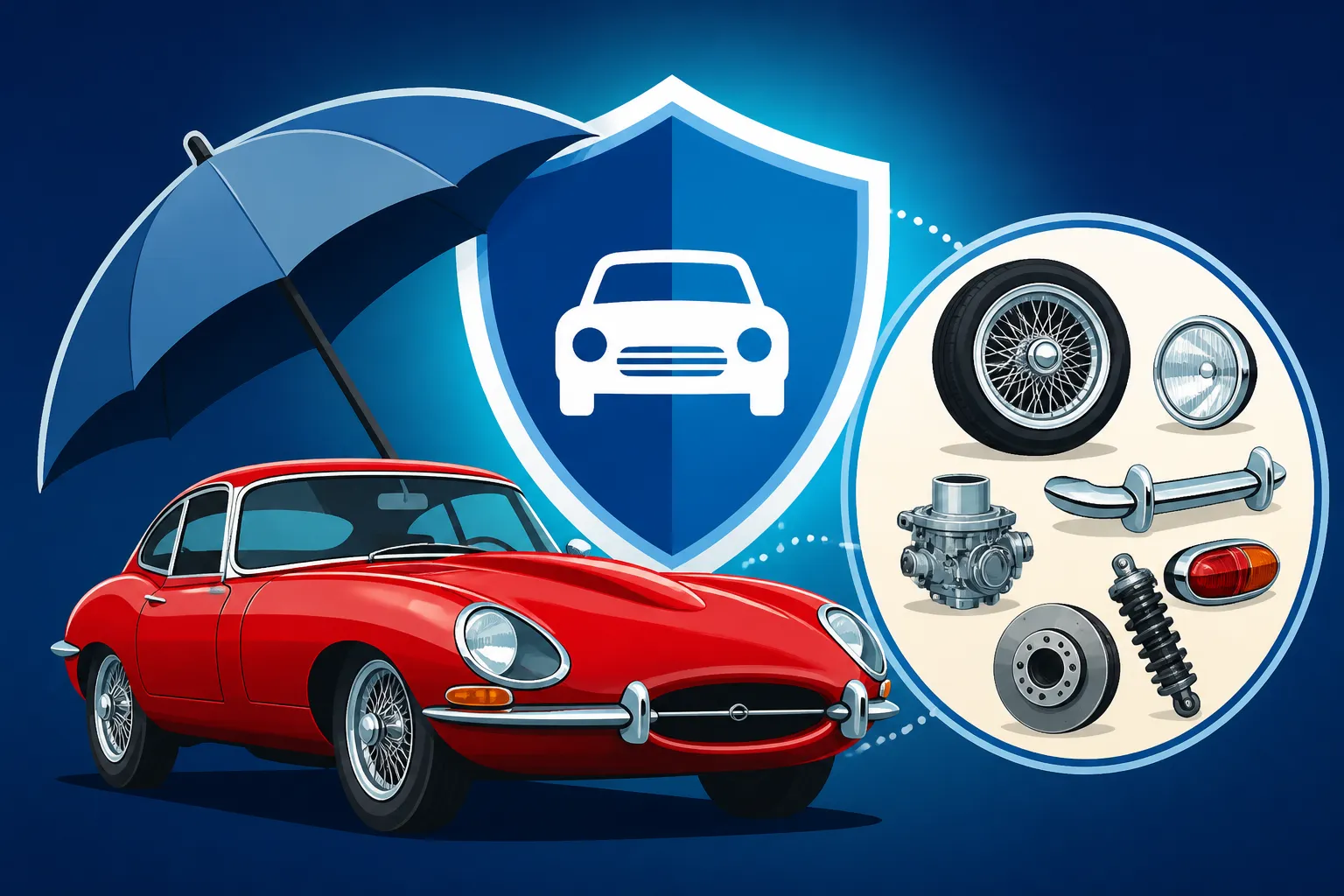
Classic car spare parts coverage is typically an endorsement or a specific feature offered by specialty insurance providers. Unlike standard policies that only cover parts on the vehicle, this specialized protection extends to valuable components that are not currently installed on your classic car. This means anything from an engine being rebuilt on a stand, a spare set of wheels and tires, a collection of interior trim pieces, extra body panels, or even vintage accessories intended for your car, all stored securely in your garage or designated storage facility. The key is that these parts are owned by you and intended for your insured classic vehicle(s).
The coverage is designed to protect these items from common perils like theft, fire, vandalism, and certain natural disasters (e.g., severe weather damage if your garage is affected). For instance, if a fire breaks out in your garage and damages a collection of rare bumpers for your upcoming restoration project, this coverage steps in. It aims to compensate you for the loss or damage based on a more realistic valuation, helping you replace those hard-to-find components and keep your project on track. This often works hand-in-hand with Agreed Value Coverage Explained for the vehicle itself, extending that same philosophy of fair valuation to your uninstalled assets.
Distinguishing it from Regular Contents and Comprehensive Coverage
It's vital to understand that spare parts coverage is distinct from both your standard auto policy's comprehensive coverage and your homeowner's insurance. Comprehensive coverage on a regular auto policy primarily protects the vehicle itself and the parts currently affixed to it. If your classic is parked and gets hail damage, the comprehensive portion of your classic policy covers the repairs to the car, including the parts on it. But it does not cover the rare carburetor sitting on your workbench.
Similarly, as mentioned before, your typical homeowner's policy, while covering general garage contents, usually has very low limits for automotive-related items or may exclude them entirely. Think of it this way: your homeowner's policy might cover your lawnmower and garden tools, but it's unlikely to adequately cover a $5,000 NOS dashboard for your vintage Mustang. Specialty insurers, like Hagerty, deeply understand this distinction. They offer dedicated Classic Car Insurance Add-Ons and Endorsements that precisely address these gaps, ensuring that your entire classic car ecosystem – from the vehicle itself to every precious nut and bolt you collect for it – is properly insured.
Key Elements of a Robust Spare Parts Policy
When you're looking to protect your classic car parts, you'll encounter specific terms and features that are critical to understanding how your coverage will work in the event of a claim.
Agreed Value for Your Prized Components
Just as Agreed Value Coverage Explained is the gold standard for insuring your classic vehicle itself, the same principle should apply to your spare parts. With Agreed Value for your parts, you and the insurance provider mutually agree upon the value of specific high-value components or the total value of your parts collection at the start of the policy. This means that if those parts are stolen or irrevocably damaged, the insurer will pay out that agreed-upon amount, without depreciation. This provides immense peace of mind, eliminating the guesswork and potential disputes of "actual cash value" after a loss.
To establish this agreed value, you'll typically need to provide a detailed inventory, complete with descriptions, photos, and any available receipts for purchase or restoration costs. For particularly rare or expensive individual items, an informal or formal appraisal might be beneficial, similar to how a classic car appraisal works for the vehicle. This upfront effort ensures that when a claim arises, there's no question about the true worth of your cherished components. It's the most effective way to protect your investment from market fluctuations and the harsh realities of depreciation.
Understanding Coverage Limits and Deductibles
Every insurance policy, including those for classic car parts, comes with limits and deductibles. The coverage limit is the maximum amount the insurer will pay out for a covered loss. For spare parts, this might be a single aggregate limit (e.g., $10,000 total for all parts) or it could be itemized for specific high-value components. It's crucial to assess the total value of your uninstalled parts collection and choose a limit that adequately covers it. Many policies start with a base amount, perhaps $5,000, which you can often increase for an additional premium. Don't fall into the trap of underestimating the true worth of your parts to save a few dollars; it could cost you thousands in the long run.
The deductible is the amount you're responsible for paying out-of-pocket before your insurance coverage kicks in. For example, if you have a $500 deductible and suffer a $2,000 loss of parts, the insurer would pay $1,500. Choosing a higher deductible can often lower your annual premium, but it also means you'll pay more upfront if you need to file a claim. You need to weigh the potential savings against your comfort level with a larger out-of-pocket expense in case of a loss. For collectors with substantial parts stashes, understanding these figures and tailoring them to your specific needs is a non-negotiable step in building a robust policy.
Optimizing Your Spare Parts Protection
Getting spare parts coverage is a smart move, but maximizing its effectiveness requires a proactive approach. It's not just about signing up; it's about setting yourself up for success should you ever need to file a claim.
The Essential Practice of Documenting Your Inventory
This might sound tedious, but trust me, it's the single most important thing you can do to protect your spare parts. Imagine trying to prove the value of a rare part that was stolen years ago without any documentation. It's nearly impossible. Here's a detailed approach:
- Create a Detailed Spreadsheet: List every significant spare part. Include its description, any identifying numbers (part numbers, serial numbers), condition (e.g., "NOS in original box," "restored, excellent condition," "used, good condition"), date of acquisition, and purchase price.
- Photograph Everything: Take clear, well-lit photos of each part from multiple angles. If it's NOS, photograph the packaging. If it's a restored component, show the quality of the work. For items with unique identifiers, photograph those too.
- Keep All Receipts: Maintain a meticulous record of all purchase receipts, invoices for restoration work, and even shipping documents. These are invaluable for proving ownership and value. This is similar to the documentation needed for How to Prove Restoration Costs to an Insurer for your vehicle itself.
- Obtain Appraisals for High-Value Items: For exceptionally rare or expensive individual parts (e.g., a complete vintage engine assembly, a set of rare magnesium wheels), consider a formal appraisal from a qualified expert. This provides independent verification of its value.
- Digital and Physical Backups: Store all your documentation—spreadsheets, photos, scans of receipts and appraisals—in at least two locations. Keep a physical binder and a digital backup on a cloud service or external hard drive.
This level of documentation not only streamlines the process when you're getting a quote but also makes any future claims much smoother and more likely to result in a fair payout.
Collaborating with Specialty Insurers for Comprehensive Protection
When it comes to insuring classic cars and their parts, not all insurers are created equal. Trying to navigate this with a standard auto insurance provider is often a frustrating exercise because they simply don't understand the nuances of collectible values. That's why working with specialty insurers is paramount. Companies like Hagerty or American Collectors Insurance specialize in classic vehicles and offer policies specifically designed for collectors. They understand the intricacies of classic car valuation, including the importance of spare parts.
When you're shopping for coverage, ask specific questions:
- "What is your approach to valuing uninstalled spare parts?"
- "Do you offer Agreed Value for individual high-value parts, or is it an aggregate limit?"
- "Are there specific storage requirements for my spare parts collection?" (This can tie into Garage Storage Requirement for Classic Cars).
- "What documentation do you require to establish the value of my parts?"
- "How does your claims process work for damaged or stolen parts?"
Many specialty insurers will offer spare parts coverage as a standard add-on or a significant endorsement to your existing classic car policy. They often have experience with Requirements for Insuring Automobilia and Parts and can guide you through the process of correctly listing and valuing your collection. Their expertise ensures that your entire collection, from the pristine vehicle to the boxes of rare parts in your garage, receives the appropriate level of protection. You might even want to compare different providers by looking at resources like Best Classic Car Insurance Companies to find the right fit for your unique collection.
Case Studies and Common Pitfalls
Understanding the theory is one thing, but seeing how spare parts coverage plays out in real life, and where people often go wrong, can really drive home its importance.
Real-World Scenarios Where Coverage Made a Difference
Let's look at a couple of situations where dedicated spare parts coverage saved the day:
-
Scenario 1: The Stolen Engine Build
David, a collector in Arizona, had a highly sought-after 427 cubic inch V8 engine for his '67 Corvette being meticulously rebuilt in his detached garage. He'd spent over $15,000 on parts and machine work, carefully documenting everything. One night, his garage was broken into, and the partially assembled engine, along with a rare, period-correct manifold, was stolen. Thanks to his comprehensive classic car policy which included specific spare parts coverage with an agreed value of $20,000 for the engine and components, David was able to file a claim. Because he had detailed receipts and photos, his insurer, like those discussed in Hagerty Classic Car Insurance Review, swiftly processed the claim. He received a payout that allowed him to purchase a replacement engine block and parts, continuing his restoration project with minimal financial setback. Without this coverage, he would have been out tens of thousands of dollars, as a standard homeowner's policy would have severely undervalued the specialized engine. This also directly relates to the importance of insuring a vehicle under restoration. -
Scenario 2: Fire Devastates a Parts Cache
Maria, from Florida, was restoring a classic British roadster and had amassed a large collection of NOS electrical components, gauges, and interior trim pieces, stored in a climate-controlled section of her garage. A freak electrical fire in her garage caused extensive damage, destroying much of her parts stash. Her homeowner's insurance provided some coverage for general contents, but the specific sub-limit for automotive parts was only $1,500. Fortunately, Maria had an additional spare parts endorsement on her classic car insurance policy with a $10,000 limit. After providing her detailed inventory and photos, the insurer quickly assessed the damage. The coverage allowed her to replace many of the unique, hard-to-find components, salvaging her restoration plans.
Mistakes to Avoid When Insuring Your Parts
While specialized coverage is a game-changer, common errors can still undermine its effectiveness:
- Underestimating or Underreporting Value: This is perhaps the biggest pitfall. Many collectors try to save a little on premiums by reporting a lower total value for their parts collection than it's actually worth. In a claim scenario, you'll only be paid up to your declared limit, regardless of the true loss. Always declare the full, honest value of your parts.
- Lack of Documentation: As emphasized, without detailed records (photos, receipts, inventory lists), proving the existence and value of your parts to an insurer can be incredibly challenging. A claim might be denied or result in a significantly lower payout without proper proof. Remember, this is about tangible proof, similar to gathering Documents Needed for a Classic Car Quote for the entire vehicle.
- Assuming Standard Coverage is Sufficient: Relying on your homeowner's or a standard auto policy to cover high-value classic car parts is a recipe for disaster. These policies are simply not designed for the unique values involved.
- Ignoring Storage Requirements: Some specialty insurers may have specific requirements for how valuable spare parts are stored. This could include needing to be in a locked garage, a secure storage unit, or even requiring certain security measures if the value is very high. Failing to meet these requirements could jeopardize a claim.
- Not Updating Your Policy: As you acquire more parts, complete restoration steps that increase the value of stored components, or if market values for certain parts rise, it's crucial to update your policy. Your spare parts collection isn't static, and your coverage shouldn't be either. This also applies if you're building a multi-car collection and need to look into How to Insure Multiple Classic Cars.
Comparison of Coverage Options for Classic Car Parts
Here’s a quick overview of how different insurance options typically handle classic car spare parts, highlighting why specialty coverage is usually the best choice.
| Feature / Type | Standard Homeowner's Policy | Standard Auto Policy | Specialty Classic Car Spare Parts Coverage |
|---|---|---|---|
| Valuation Method | Actual Cash Value (ACV) | N/A (for uninstalled) | Agreed Value / Stated Value |
| Coverage Scope | General contents (low limits) | Installed parts only | Specific uninstalled classic car parts |
| Perils Covered | Fire, theft (often high deductible) | Collision, comprehensive (for installed) | Fire, theft, vandalism, natural disasters |
| Typical Limits | $500 – $2,500 (sub-limits for specific items) | Value of car (for installed parts) | $5,000 – $50,000+ (customizable) |
| Documentation Needed | Limited | Vehicle info | Detailed inventory, photos, receipts, appraisals |
| Best For | General household items | Daily drivers | Collectors with valuable spare classic parts |
The Long-Term Benefits of Protecting Your Spare Parts
In the grand scheme of classic car ownership, the relatively small investment in dedicated spare parts coverage yields immense returns in terms of peace of mind. It acknowledges that your collection isn't just the vehicles themselves, but also the precious components that enable their continued existence, restoration, and authenticity.
Knowing that your valuable, often irreplaceable, parts are protected against theft, fire, or damage allows you to focus on the joy of the hobby—the hunt for that perfect piece, the satisfaction of a successful restoration, or the excitement of a new project. It helps maintain the overall value of your classic vehicle investment by ensuring you can replace critical components should the unthinkable happen. Ultimately, spare parts coverage is a fundamental component of a truly comprehensive classic car insurance strategy, an essential endorsement that no serious collector should overlook.
Disclaimer
Please remember that insurance policies can vary significantly. It's always crucial to read your specific policy documents thoroughly and consult with a qualified insurance professional to understand your coverage details, limitations, and exclusions.