Restoration Coverage: How Value Increases
It's a familiar scenario for any classic car enthusiast: you've found that dream project, a true barn find, or perhaps a beloved family heirloom that's seen better days. You envision its former glory, the chrome gleaming, the engine roaring. But the thought of sinking thousands of dollars and countless hours into a restoration project, only to have an unforeseen disaster strike before it's finished, can be incredibly daunting. What if a fire breaks out in the shop? What if crucial, irreplaceable parts are stolen? This guide will walk you through how restoration coverage works for classic cars, specifically focusing on how it protects your escalating investment and ensures the value you're building is recognized by your insurer every step of the way.
Understanding Restoration Coverage for Classic Cars
Embarking on a classic car restoration is a labor of love, a significant financial commitment, and often a multi-year journey. The challenge, from an insurance perspective, is that the car's value isn't static. It changes dramatically as you progress from a disassembled shell to a pristine, road-ready masterpiece. Standard auto insurance simply isn't equipped to handle this dynamic value, nor the unique risks associated with a car that's constantly in pieces or being worked on.
What is Restoration Coverage and Why You Need It
Restoration coverage is a specialized type of insurance designed specifically for classic cars that are actively undergoing significant repair, renovation, or rebuilding. Unlike a standard comprehensive or collision policy that covers a finished vehicle driven regularly, restoration coverage understands that your vehicle might be in various states of disassembly, stored in a workshop, or even transported between different specialists. It's built to protect the cumulative investment you're pouring into your project, from the initial purchase price to every new panel, engine component, paint job, and upholstery stitch.
Think about it: if you have a 1969 Ford Mustang that you bought for $15,000 as a rolling chassis, and you've already invested $30,000 into bodywork, an engine rebuild, and new suspension components, your actual investment is now $45,000. If a fire then consumes your garage, a standard policy might only offer you the initial $15,000 market value of the unrestored car, leaving you significantly out of pocket. Restoration coverage aims to prevent this financial heartbreak by insuring the current value of your car, including the parts and labor invested. It's often bundled with what's known as Vehicle Under Construction Coverage.
How Restoration Coverage Protects Your Investment
This specialized coverage extends its protective umbrella over a range of scenarios that are particularly relevant during a restoration project. It’s not just about what happens when the car is on the road; it’s about what can happen in the garage, during transport, or even to the parts waiting to be installed.
- Theft: Imagine having rare, New Old Stock (NOS) parts stored securely, or the freshly chromed bumpers sitting in your garage, only for them to be stolen. Restoration coverage often includes specific provisions for Spare Parts Coverage for Classic Cars Explained, protecting these valuable components even if they're not yet installed on the vehicle. This is critical because many classic car parts are hard to find and expensive to replace.
- Fire: Garages, workshops, and even home storage areas are unfortunately susceptible to fires. Tools, solvents, and electrical equipment can pose risks. If your classic project car, whether a full chassis or a partially assembled body, is damaged or destroyed by fire, this coverage will help compensate you for the car's value at the time of the incident, including the work already completed.
- Accidental Damage: Accidents happen, even in a professional shop. A dropped engine, a slip with a grinder, or damage during transport between a body shop and a paint shop can set your project back significantly. Restoration coverage can step in here, covering repairs to accidental damage incurred while the car is under active restoration, provided the damage wasn't due to gross negligence or improper techniques by the restorer (though this can get tricky and should be discussed with your insurer).
- Vandalism or Natural Disasters: From a mischievous act in the workshop to damage from a severe hailstorm or flood, restoration coverage helps protect your evolving investment from these unpredictable events, just as comprehensive coverage would for a finished vehicle.
The peace of mind that comes with knowing your evolving investment is protected means you can focus on the intricate details of bringing your classic back to life, rather than constantly worrying about potential financial losses.
The Dynamic Nature of Value in Restoration
One of the most unique aspects of classic car restoration, from an insurance standpoint, is how the vehicle's value isn't a fixed figure. It's a moving target, constantly increasing as you pour more time, money, and expertise into the project. Recognizing and adequately insuring this incremental value is what sets restoration coverage apart.
Tracking the Incremental Increase in Value
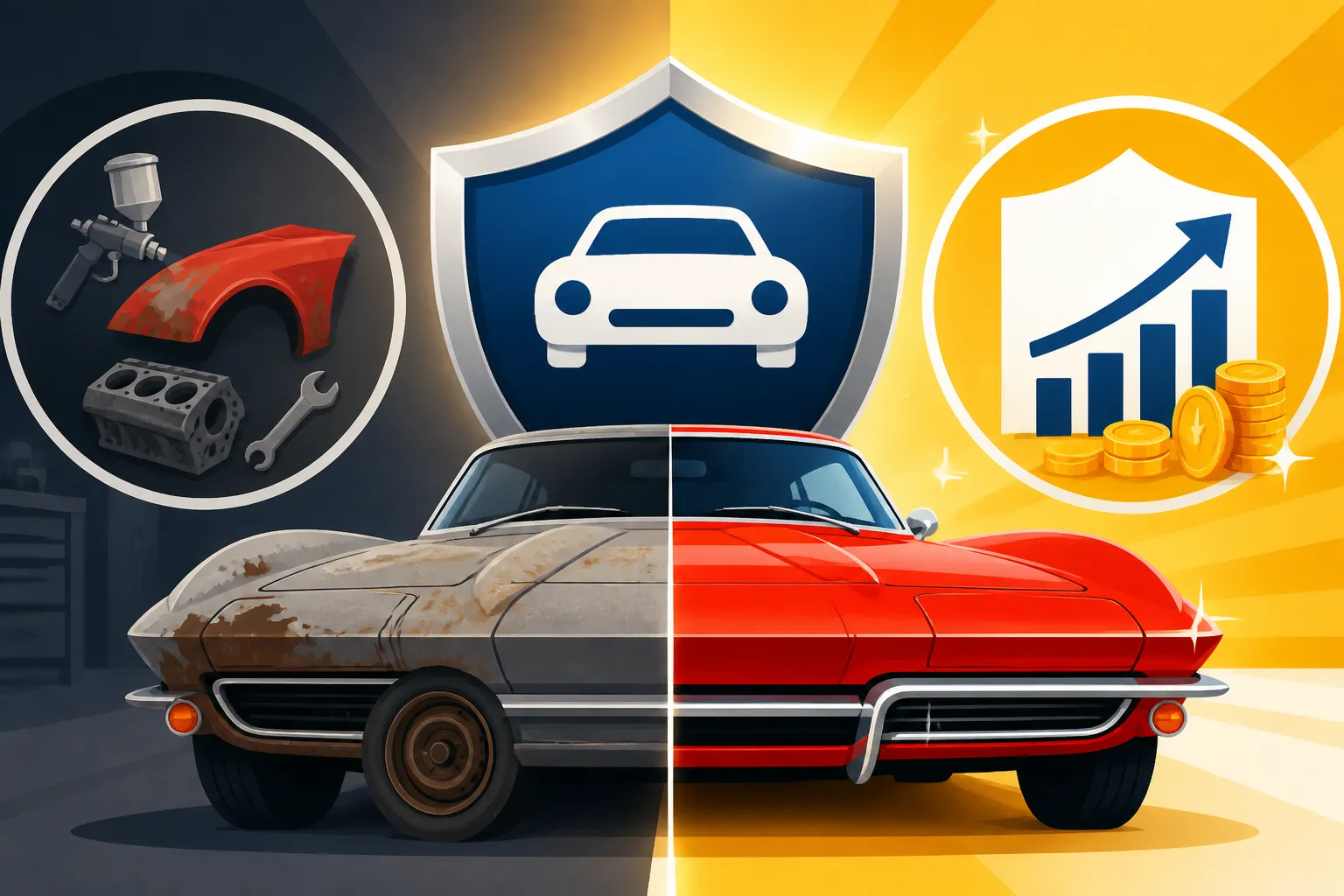
Unlike a production car where its value typically depreciates over time, a classic car undergoing a quality restoration sees its value steadily climb. Every new part, every hour of skilled labor, every expertly applied coat of paint adds to its worth. For example, a bare metal shell might be worth $5,000. Once the frame is straightened and painted, new suspension components are installed, and a rebuilt engine is dropped in, its value could easily jump to $25,000. After bodywork, paint, and a fully restored interior, it might be worth $50,000 or more.
This incremental increase in value is precisely what restoration coverage is designed to address. It acknowledges that the "market value" of your car at the start of the project is vastly different from its value halfway through, let alone upon completion. This is a crucial distinction from standard policies that might only look at the initial purchase price or a generalized market value for a similar, unrestored vehicle. Specialty insurers, like Hagerty or Grundy, are particularly adept at understanding this nuanced valuation process because they deal with collectors and restorers every day.
Documenting Your Restoration Journey for Insurance
Meticulous record-keeping isn't just good practice for tracking your expenses; it's absolutely vital for ensuring your restoration coverage accurately reflects your car's increasing value and that any potential claim is handled smoothly. Insurers aren't mind readers, and they rely on tangible evidence to justify the increased value of your policy.
Here's what you should be diligently documenting:
- Detailed Receipts and Invoices: Keep every single receipt for parts purchased, whether it's from a specialty supplier, an online vendor, or a swap meet. Get itemized invoices for all professional services, including machine shop work, bodywork, paint, upholstery, and specialized engine building. These documents are proof of your financial investment.
- Photographic and Video Evidence: Take "before" photos and videos of the car and individual components. As work progresses, regularly photograph and video the stages of restoration. Show new parts being installed, body panels being prepped, engine components being assembled, and the interior transformation. This visual diary provides undeniable proof of the labor and parts invested.
- Time Logs: While not always directly reimbursable, a log of your own labor hours, especially for skilled tasks, can sometimes help support the overall appreciation in value, even if it's not a direct financial cost. This shows the commitment and effort that translates into a higher-quality finished product.
- Appraisals (Optional but Recommended): For extensive or high-value restorations, consider getting periodic appraisals from a qualified classic car appraiser. These can officially document the increasing value at different milestones, providing an expert third-party validation that your insurer will appreciate. You might find it useful to read about How Classic Car Appraisals Work for Insurance.
By keeping these records, you're building a strong case for your car's evolving value, making it easier for your insurer to adjust your coverage and for you to receive a fair payout should the unthinkable happen.
How Restoration Coverage Accounts for Value Increases
The genius of specialized restoration coverage lies in its flexibility to adapt to your car's escalating worth. It understands that the moment you bolt on those expensive headers or finish that flawless paint job, the vehicle's value has already changed. This isn't a "set it and forget it" type of policy; it requires a partnership between you and your insurer.
Scheduled Increases in Agreed Value
One of the most common and effective ways restoration coverage handles value increases is through a system of "agreed value" adjustments. With an Agreed Value Coverage Explained policy, you and the insurer agree on a specific value for your classic car at the outset. If a total loss occurs, that's the amount you'll be paid, no depreciation or haggling over market value. For restoration projects, many specialty insurers allow you to incrementally increase this agreed value as your project progresses.
Here's how it often works:
- Initial Agreed Value: When you first purchase the policy, you'll establish an agreed value based on the car's condition at the start of the restoration (e.g., $20,000 for a solid but disassembled shell).
- Milestone Updates: As you reach significant milestones – say, the engine is fully rebuilt and installed, or the bodywork and paint are complete – you contact your insurer. You provide them with your detailed documentation (receipts, photos, invoices) showing the additional investment made.
- Revised Agreed Value: Based on your documentation, the insurer will agree to a new, higher value for your vehicle. For example, after dropping in a rebuilt big block, your agreed value might jump to $40,000. This process continues until the restoration is complete and you have the final agreed value.
- Premium Adjustments: Naturally, as the agreed value of your car increases, your premium will also adjust to reflect the higher amount of risk the insurer is taking on. However, this slight increase is a small price to pay for ensuring your massive investment is fully protected.
This proactive approach ensures that your policy always reflects the true financial commitment you've made, preventing a situation where you're left underinsured.
Automatic or Inflation Guard-like Adjustments
While scheduled increases based on your input are common, some specialized policies might offer mechanisms that provide a bit of automatic buffer for rising costs or incremental work. This is similar in spirit to Inflation Guard Coverage Explained for finished classics, which automatically increases your agreed value by a small percentage each year to account for market appreciation.
For restoration coverage, this might manifest in different ways:
- Pre-approved Incremental Value: Some policies might allow for a set percentage increase in value without immediate detailed documentation, provided you maintain records. This gives you a little leeway for small expenses that might not warrant an immediate call to your insurer.
- Built-in Buffer for Parts & Labor: A policy might include a small, automatic buffer for parts and labor, recognizing that costs can fluctuate. For instance, it might state that the agreed value can increase by up to 5% between formal updates, provided you can justify the expenses if a claim arises.
It's crucial to understand that even with these features, they are usually supplementary and do not replace your responsibility to actively communicate major increases in value to your insurer. Always clarify with your provider what specific mechanisms they have in place to account for value growth during restoration.
The Importance of Communication with Your Insurer
This cannot be stressed enough: open, regular communication with your classic car insurance provider is the bedrock of effective restoration coverage. You are in control of the project, and therefore, you are the primary source of information for your insurer regarding its evolving value.
- Be Proactive: Don't wait for your annual renewal to discuss significant progress. If you've just invested $15,000 in a new crate engine and transmission, pick up the phone.
- Provide Documentation: Whenever you request a value adjustment, be ready to provide the invoices, receipts, and photos that support the increase. This makes the process smooth and straightforward.
- Ask Questions: If you're unsure how a particular expense or stage of restoration impacts your coverage, ask your agent. For example, if you're sending the engine out for a specialized rebuild, confirm if that off-site work is covered.
- Understand Your Policy: Read the fine print of your restoration coverage. Understand its limitations, what documentation it requires, and how often you're expected to provide updates. This will help you avoid Common Classic Car Insurance Mistakes to Avoid.
By maintaining a transparent and proactive dialogue with your insurer, you ensure that your policy accurately reflects your investment, preventing potential disputes or underpayment in the event of a claim.
Practical Steps to Maximize Your Coverage and Value
Navigating the world of classic car insurance, especially for a restoration project, can feel a bit overwhelming. But by taking a few deliberate steps, you can ensure your project is well-protected and that its increasing value is properly recognized.
Choosing the Right Policy and Insurer
This is perhaps the most critical step. Not all insurance companies are created equal when it comes to classic cars, and even fewer truly understand the intricacies of a car under restoration.
- Opt for Specialty Insurers: Steer clear of standard auto insurers for your classic project. Their policies are typically designed for daily drivers and won't offer the specialized coverage, agreed value options, or understanding of restoration risks that you need. Instead, look to Best Specialty Classic Car Insurers like Hagerty, Grundy, American Collectors Insurance, or J.C. Taylor. These companies are built by enthusiasts, for enthusiasts, and truly get the unique nature of the hobby.
- Inquire About Specific Restoration Riders: When getting quotes, explicitly ask about "restoration coverage," "vehicle under construction coverage," or similar endorsements. Don't assume it's included in a general "collector car policy." Confirm how they handle incremental value increases and what documentation they require.
- Compare Agreed Value Mechanisms: Understand how different insurers handle the agreed value. Do they allow flexible updates? Are there any automatic increases? What's their process for submitting documentation? Compare these details, not just the premium price.
A solid policy from a reputable specialty insurer is the foundation of protecting your restoration project.
Regular Updates and Appraisals
As discussed, your car's value during restoration isn't static. Your insurance policy shouldn't be either.
- Scheduled Reviews: Aim for quarterly or semi-annual reviews with your insurer, especially during intense periods of work. Even if you haven't hit a major milestone, a quick check-in can ensure everything is up-to-date.
- Major Milestone Updates: Always contact your insurer after completing a significant stage, such as an engine rebuild, body-off restoration, or a full paint job. Provide all your accumulated documentation.
- Professional Appraisals: For particularly complex or high-dollar restorations, a professional appraisal can be invaluable. An independent appraiser can assess the quality of the work and the market value of the car at various stages. This provides an objective, expert opinion that significantly strengthens your case for a higher agreed value with your insurer. You might need to consider Appraisal Requirements for Classic Car Insurance when choosing a policy.
- Inflation Guard: Once the car is finished and on the road, consider adding inflation guard coverage to your policy. This optional endorsement helps ensure your agreed value keeps pace with the appreciating classic car market without requiring an annual re-appraisal, offering a small percentage increase each year.
Protecting Parts and Components
The value of a restoration isn't just in the assembled vehicle; it's also in the rare, expensive, and often hard-to-find components that make it whole.
- Dedicated Spare Parts Coverage: Many specialty policies offer specific coverage for spare parts, tools, and automobilia. This is crucial for a restoration where you might have engines, transmissions, trim pieces, or interior components stored separately from the car itself. Ensure the limits for this coverage are adequate for your collection of parts.
- Documentation for Parts: Just like with the car itself, keep meticulous records for all significant parts purchases. This includes photos of the parts, receipts, and any documentation proving their authenticity or rarity.
- Secure Storage: While insurance covers theft, prevention is always the best policy. Ensure your workshop, garage, and storage areas for parts are secure. This includes robust locks, alarm systems, and potentially even surveillance. Some insurers might offer discounts for enhanced security measures, and many require secure storage as part of their policy terms, as explored in Garage Storage Requirement for Classic Cars.
By diligently following these steps, you'll not only protect your significant investment in your classic car restoration but also ensure that its value is accurately reflected and continually updated, providing invaluable peace of mind throughout your journey.
Comparative Overview: Value Stages in Classic Car Restoration
To illustrate how restoration coverage impacts your classic car's value over time, let's look at a hypothetical example: a 1967 Chevrolet Camaro base model purchased as a rolling shell with a blown engine.
| Value Stage | Description | Estimated Value (Without Restoration Coverage) | Estimated Value (With Restoration Coverage Updates) |
|---|---|---|---|
| Initial Purchase | Rolling shell, no engine, rust, disassembled. | $10,000 (Purchase Price) | $10,000 (Initial Agreed Value) |
| Stage 1: Drivetrain & Chassis | Frame off restoration complete, rebuilt engine/trans, new suspension. | $10,000 (Still seen as "project car" by standard insurer) | $35,000 (Agreed Value updated with $25K investment) |
| Stage 2: Bodywork & Paint | Body fully restored, rust removed, new panels, show-quality paint. | $10,000 (Still seen as "project car") | $75,000 (Agreed Value updated with $40K investment) |
| Stage 3: Interior & Final Assembly | Full interior, chrome, electrical, final tuning, roadworthy. | $10,000 (Still seen as "project car") | $110,000 (Final Agreed Value with $35K investment) |
| Finished Car | Concourse or driver quality, fully completed restoration. | $10,000 (Standard policy might only cover initial value or depreciate) | $110,000 (Final Agreed Value) |
This table clearly shows the dramatic difference restoration coverage makes. Without it, your potential payout in case of a loss would likely be stuck at the initial, low purchase price, ignoring all the value you've meticulously added. With restoration coverage and diligent updates, your policy ensures that your investment grows and is protected every step of the way, reflecting the true worth of your labor of love.
Disclaimer
Please remember that insurance policies, including those for classic cars and restoration projects, can vary significantly in their terms, conditions, and coverage limits. The information provided in this guide is for general informational purposes only and does not constitute professional insurance advice. It is always essential to thoroughly read your specific policy documents, understand their nuances, and consult directly with a qualified insurance agent or broker to ensure your classic car restoration project is adequately protected according to your individual needs and circumstances.