Why Stated Value Can Shortchange You
One of the biggest heartbreaks for any classic car owner is the thought of something happening to their cherished vehicle. Even worse is the nightmare scenario of a total loss, only to discover your insurance payout doesn't even come close to what your classic is truly worth. This gut-wrenching experience often stems from a misunderstanding or misapplication of "stated value" insurance policies, which, despite sounding appealing, can drastically shortchange you when it matters most. This guide will walk you through the nuances of classic car valuation, expose the pitfalls of stated value coverage, and explain why "agreed value" is the superior choice for safeguarding your automotive investment.
Understanding the Basics of Classic Car Valuation for Insurance
When you insure a regular daily driver, the process is pretty straightforward. The insurance company assesses its market value, usually based on depreciation and comparable sales. But a classic car isn't just transportation; it's a piece of history, a work of art, and often a significant financial and emotional investment that defies typical depreciation models. This unique nature is precisely why traditional insurance valuation methods often fail collectors.
What is Actual Cash Value ACV and Why it Fails Classics
Let's start with the most common type of valuation you'll find on a standard auto policy: Actual Cash Value, or ACV. This method calculates your vehicle's value at the time of a loss by taking its original cost and subtracting depreciation. For a brand-new sedan, this might be perfectly acceptable. The car loses value the moment it drives off the lot, and its purpose is primarily utilitarian.
However, applying ACV to a classic car is like trying to fit a square peg in a round hole – it just doesn't work. Classic cars often appreciate in value, especially if they're rare, well-maintained, or have a significant history. If you have a beautifully restored 1969 Chevrolet Camaro that's worth $70,000, an ACV policy might only pay out $10,000 based on its original sale price decades ago and an arbitrary depreciation schedule. That leaves you holding the bag for a $60,000 loss, which is precisely the frustration that drives many collectors away from standard policies. You need an approach that recognizes the unique nature of your collector vehicle, something a standard ACV policy simply cannot provide.
The Promise of Agreed Value Coverage
This is where "agreed value" coverage shines like a perfectly polished chrome bumper. With an agreed value policy, you and the insurance company, before your policy even goes into effect, agree on the precise value of your classic car. This agreed-upon amount is the exact figure you will receive if your vehicle is declared a total loss, minus any applicable deductible. There's no negotiation, no surprises, no sudden depreciation calculations after the fact.
This peace of mind is invaluable for collectors. Imagine insuring your prized 1965 Ford Mustang for an agreed value of $80,000. If it's totaled in a fender bender or stolen, you know you'll get $80,000 (less your deductible) to help you replace or rebuild it. This contrasts sharply with the uncertainty of other valuation methods. Many specialized insurers, like Hagerty, built their reputation on offering robust agreed value policies, understanding that collectors deserve this level of protection. To learn more about how this works, check out our detailed guide on Agreed Value Coverage Explained.
The Perils of Stated Value Coverage
Now, let's talk about "stated value" policies. On the surface, they sound a lot like agreed value, and that's often where the confusion, and the potential for heartache, begins. A stated value policy allows you to "state" a value for your car, and the insurer will often list this amount on your policy declarations page. The problem is, it's not a guarantee.
How Stated Value Policies Work in Theory vs. Reality
In theory, a stated value policy sounds like a good compromise: you tell them what your car is worth, they write it down, and you both move on. The premium is often calculated based on this stated amount, which can lull owners into a false sense of security. You might think, "Great, I've got my 1970 Dodge Challenger R/T insured for $120,000, so if anything happens, that's what I'll get."
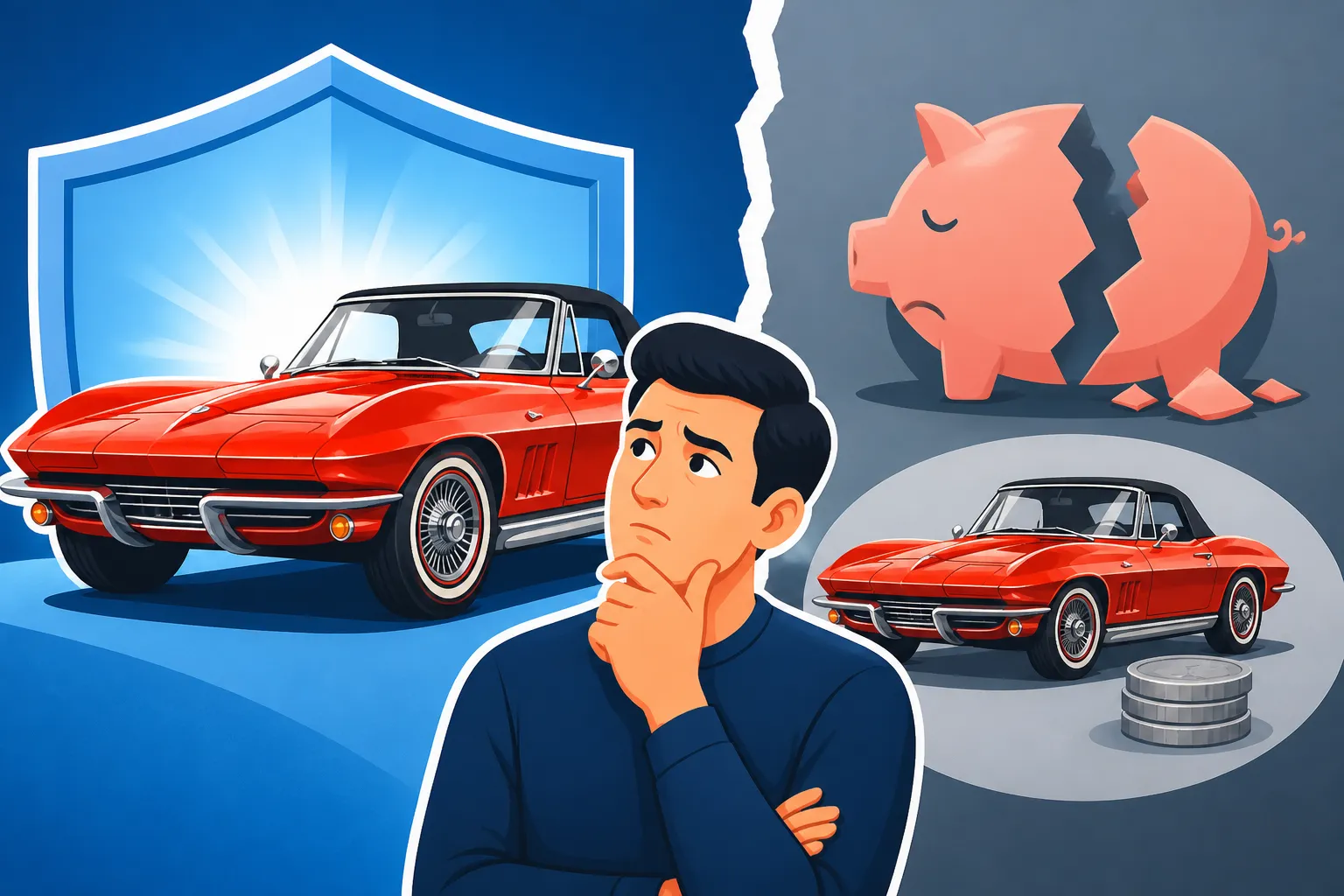
However, the reality is far more complex and often disappointing. While you state a value, the insurance company typically reserves the right to pay you the lesser of the stated value, the actual cash value, or the market value at the time of loss. This crucial distinction often gets buried in the fine print of the policy documents, leaving collectors vulnerable. You pay premiums expecting one thing, only to find out after a claim that the rules are entirely different. This is why understanding Agreed Value vs Stated Value vs Actual Cash Value is so critical.
Real-World Scenarios Where Stated Value Falls Short
Let's look at a couple of scenarios to illustrate just how stated value can shortchange you:
-
Scenario 1: The "Lesser Of" Trap. You own a beautifully restored 1957 Chevrolet Bel Air, which you've stated at $90,000. It's a fantastic car, meticulously maintained. Unfortunately, you're involved in an accident, and the car is totaled. Your insurer, under a stated value policy, conducts an appraisal. They determine that while the car is nice, its "actual cash value" (considering it's a 1957 model, even if restored) might only be $30,000, or perhaps they find some comparable sales in your area that push the "market value" down to $70,000. Because your policy states they pay the lesser of the stated value, ACV, or market value, you might only receive $30,000 or $70,000, instead of the $90,000 you expected and paid premiums on. This can leave you tens of thousands of dollars short.
-
Scenario 2: The Evolving Market. Imagine you insured your classic 1980s Porsche 911 a few years ago for a stated value of $60,000. Since then, the market for these particular Porsches has skyrocketed, and your car is now realistically worth $100,000. If it's totaled, the stated value policy will not pay you the new market value. It will pay the lesser of your stated $60,000 or the market value at the time of loss. Even if the market value is now $100,000, you are capped at your stated $60,000, effectively missing out on the appreciation of your investment. This highlights why for rising-value cars, agreed value is indispensable.
The "Lesser Of" Clause: The Sneaky Trap
This "lesser of" clause is the absolute Achilles' heel of stated value insurance for classic cars. It's the mechanism that allows insurance companies to honor the lowest possible valuation when a loss occurs, rather than the amount you believe you've insured your vehicle for. This clause typically dictates that the payout will be the lowest amount among:
- The stated value on your policy.
- The actual cash value (ACV) of the vehicle at the time of loss.
- The market value of the vehicle at the time of loss.
For a classic car, the ACV is almost always going to be significantly lower than its collector market value. A 1967 Mustang might have an ACV of a few thousand dollars, but its true collector value could be $40,000 or more. This means that even if you "state" $40,000, the insurer could legally pay you the ACV. It's a safety net for the insurance company, not for you, the collector. This fundamental difference is why specialty insurers who cater to collectors almost exclusively offer agreed value, because they understand the unique financial and sentimental value these vehicles hold. When comparing policies, you really need to understand How to Compare Classic Car Insurance Quotes and scrutinize this critical aspect.
Protecting Your Investment: Why Agreed Value is the Only Way
When it comes to insuring your beloved classic, there's truly only one gold standard that offers genuine peace of mind: agreed value coverage. This isn't just about getting a higher payout; it's about eliminating uncertainty and ensuring your investment is fully protected against the unexpected.
Securing Your Classic's True Worth
With agreed value, the guesswork is completely removed. You and your insurer settle on a specific dollar amount that represents your car's true collector value, and that figure is locked in. If your 1963 Split-Window Corvette, agreed at $150,000, is totaled, you get $150,000. Period. This security means you can confidently enjoy your classic, knowing that if the worst happens, you won't be left scrambling to make up a significant financial deficit.
This type of policy truly recognizes that classic cars are not mere transportation; they are appreciating assets, historical artifacts, and often the culmination of years of hard work and passion. Specialty insurers like Hagerty excel at providing this tailored protection, understanding the unique needs of the collector community. They staff experts who know the classic car market inside and out, making the valuation process fair and accurate. Without this certainty, you're essentially gambling with your investment every time your car leaves the garage. This is also why many insurers require specific Classic Car Insurance Eligibility Requirements to qualify for agreed value.
The Appraisal Process and Agreed Value
Establishing an accurate agreed value often involves an appraisal. This isn't always a requirement for every classic car, especially for those with readily available market data, but it's a powerful tool to ensure your valuation is solid. A professional classic car appraisal provides an unbiased, documented assessment of your vehicle's condition, originality, modifications, provenance, and overall market value.
This appraisal serves as concrete evidence to the insurer, justifying the agreed value you've settled upon. For exceptionally rare, highly modified, or recently restored vehicles, an appraisal is virtually indispensable. It removes any doubt about the car's worth and strengthens your position for an accurate agreed value. It's a small upfront investment that can save you significant financial pain down the road. If you're wondering how this process works, we have a detailed guide on How Classic Car Appraisals Work for Insurance.
Working with a Specialty Insurer
The biggest differentiator between effective classic car insurance and inadequate coverage often comes down to who you choose to insure with. Traditional auto insurers, while excellent for your daily commuter, rarely possess the specialized knowledge, market insights, or policy structures necessary to properly protect a classic. Their systems are built for depreciation, not appreciation.
Specialty classic car insurers, like Hagerty or Grundy, are different. Their entire business model revolves around understanding the nuances of the collector car market. They employ staff who are enthusiasts themselves, have access to extensive valuation databases, and offer policies specifically designed for collectors. This includes:
- Agreed Value Coverage: Their standard offering, ensuring you get paid what your car is truly worth.
- Lower Premiums: Because classics are driven less and generally treated with more care, specialty policies are often surprisingly affordable compared to regular auto insurance.
- Customized Coverages: Options for spare parts, restoration coverage, automobilia, and even trip interruption.
- Flexible Mileage Plans: Catering to limited annual use, knowing you're not daily driving your cherished vehicle.
Choosing a specialty insurer means partnering with a company that "gets" the classic car hobby. They understand that your 1970 Plymouth Barracuda isn't just a car; it's a passion. This understanding translates into better coverage, fairer claims processes, and ultimately, greater peace of mind for you.
Key Differences: Stated Value vs. Agreed Value vs. Actual Cash Value
Understanding the distinctions between these three valuation methods is paramount for any classic car owner. Here's a clear breakdown to help you see why agreed value stands head and shoulders above the rest for collector vehicles.
| Feature | Actual Cash Value (ACV) | Stated Value | Agreed Value |
|---|---|---|---|
| Determination | Market value at time of loss, minus depreciation. | You suggest a value; insurer may agree to list it. | You and insurer agree on a fixed amount before policy. |
| Payout Guarantee | No. Based on depreciation/market at time of loss. | No. Payout is often "lesser of" stated, ACV, or market. | Yes. Guaranteed payout for total loss (less deductible). |
| For Classics? | NOT Recommended. Fails to account for appreciation. | Highly Risky. Appears appealing but has major caveats. | HIGHLY Recommended. Tailored for collector vehicles. |
| Premium Basis | Standard algorithms, mass market data. | Based on your stated value, but payout isn't guaranteed. | Based on the mutually agreed-upon value. |
| Appraisal Role | Not typically used. | May be requested, but doesn't guarantee payout amount. | Often used to establish and support the agreed amount. |
| Market Fluctuations | Reflects market downward trends; ignores upward trends for classics. | Caps payout at stated value, even if market increases. | Can be updated to reflect market appreciation over time. |
| Peace of Mind | Low. High uncertainty regarding payout. | False sense of security. High risk of being shortchanged. | High. Clear, guaranteed payout for your cherished asset. |
This table clearly illustrates the inherent risks associated with stated value and ACV when it comes to classic cars. For collectors, the guarantee and clarity of agreed value coverage are simply unmatched, ensuring your passion and investment are truly safeguarded. You can delve deeper into Why Agreed Value Matters for Classics to fully grasp its importance.
Making an Informed Choice for Your Prized Possession
Choosing the right insurance for your classic car isn't just a transaction; it's a critical decision that impacts your financial security and peace of mind as a collector. Don't let confusing terminology or seemingly attractive premiums lead you down a path that leaves you vulnerable.
Questions to Ask Before Choosing a Policy
Before you sign on the dotted line, have a candid conversation with your insurance provider. Don't be afraid to ask direct questions about how your policy will handle a total loss. Here are a few crucial questions to put to any insurer:
- "Is this an 'agreed value' policy? Will I receive the exact amount listed on my policy declarations page if my car is totaled, regardless of its market value at the time of loss?" This is the most important question. A clear "yes" means true agreed value. Any hesitation or explanation about "market value" or "actual cash value" should be a red flag, indicating a stated value policy.
- "Do you require an appraisal for my vehicle, or how do you determine the agreed value?" Understand their process. Some insurers, especially for well-known models, may use their own databases, while others will always ask for an independent appraisal.
- "What happens if my car's market value appreciates significantly during the policy term?" A good agreed value policy might have an "inflation guard" endorsement or allow you to easily adjust the agreed value at renewal. If the answer implies you're stuck at the initial stated amount, it's not ideal.
- "Are there any specific exclusions I should be aware of regarding how you value the car in a claim?" Always ask about the fine print. You want transparency, not surprises.
Asking these questions helps you cut through the jargon and get straight answers about the level of protection you're truly buying. For more guidance, our article on How to Choose Classic Car Insurance provides an extensive checklist.
Reviewing Your Policy Annually
The classic car market isn't static. Values can fluctuate, restorations can be completed, and modifications can enhance or change a car's worth. This is why it's incredibly important to review your classic car insurance policy annually. Don't just let it auto-renew without a second thought!
Take the time to assess if the agreed value still accurately reflects your car's current worth. If you've done significant restoration work, or if your model has seen a jump in market demand, you'll want to adjust your agreed value upwards. Conversely, if values have dipped (though less common for true classics), you might adjust it down to save on premiums, though for many, protecting the peak value is the priority. Many specialty insurers, like Hagerty, even offer valuation tools and resources to help you stay on top of market trends. Regular reviews ensure that your coverage remains perfectly aligned with the real-world value of your cherished classic, keeping you fully protected year after year.
Disclaimer
Please remember that insurance policies and their terms can vary widely by provider and state. The information provided in this guide is for general informational purposes only and does not constitute professional insurance advice. Always consult with a qualified insurance professional to discuss your specific needs and policy options before making any decisions.