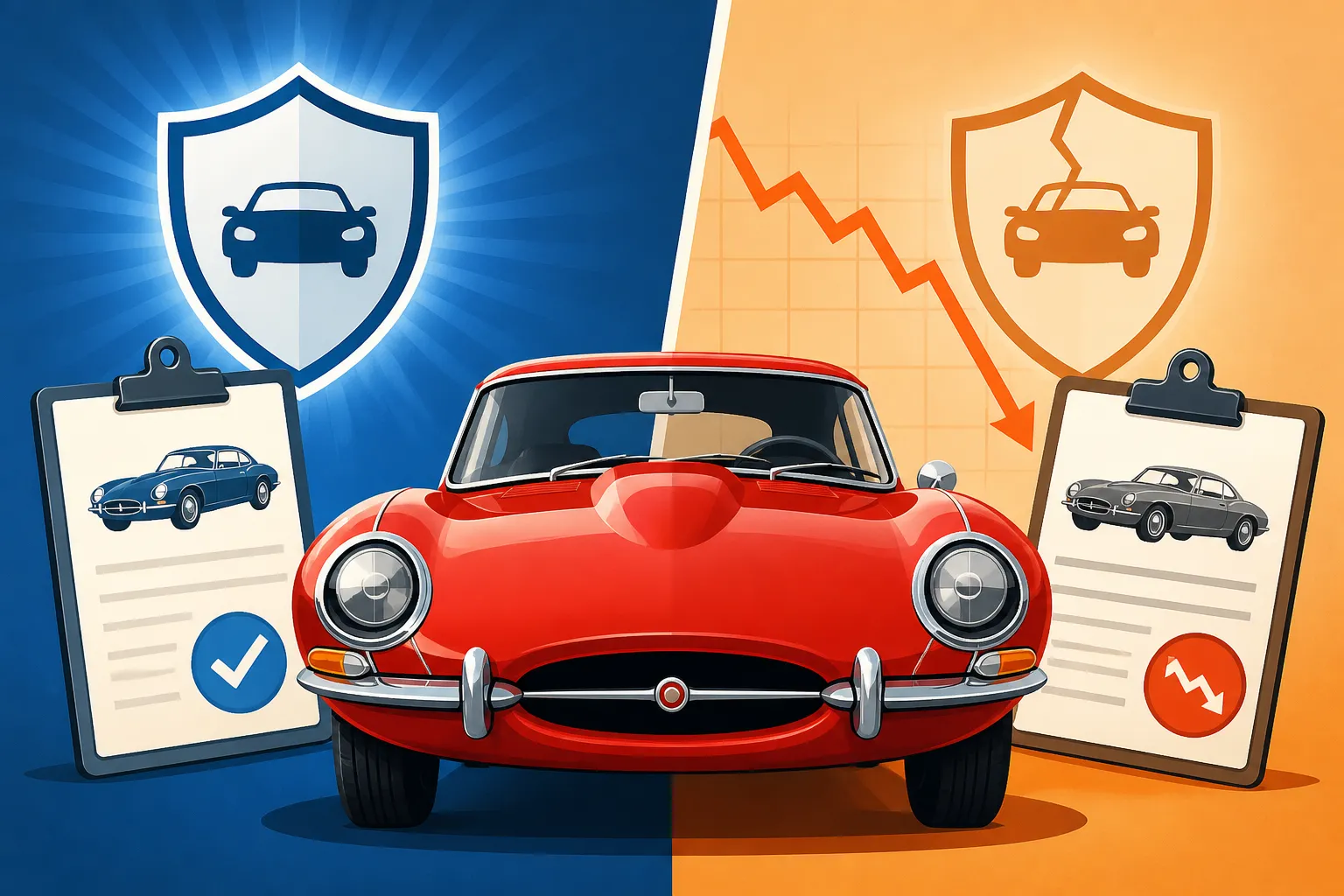
Agreed Value vs Market Value Explained
One of the most perplexing aspects of owning a classic car, beyond finding that perfect project or rare part, is navigating the confusing world of insurance valuations. It's frustrating to pour your heart, soul, and hard-earned money into a cherished vehicle, only to wonder if an insurer truly understands its irreplaceable value. This guide will meticulously break down the critical differences between agreed value and market value, empowering you to make informed decisions and protect your automotive investment.
Understanding Classic Car Valuation for Insurance
When you insure a daily driver, the process is pretty straightforward. Your car is a depreciating asset, meaning its value goes down over time, influenced by mileage, condition, and age. But a classic car? That's a whole different animal. It's often an appreciating asset, or at the very least, one whose value is tied to its unique history, restoration quality, and market desirability, not just its age or odometer reading.
The Fundamental Difference: Protection vs. Depreciation
The core issue here stems from how standard insurance policies are built. They are designed for a world where cars lose value every day they're driven, every year they age. This depreciation model is ingrained in their algorithms and underwriting. However, for a classic car owner, your focus isn't on how much your car has depreciated; it's on preserving its current, often growing, value and the significant investment you've made. You're looking for financial protection that respects the vehicle's collectible status, not just its utility as transportation.
Imagine spending years restoring a vintage Chevrolet Impala, pouring tens of thousands into its pristine condition. A standard auto policy, built on the depreciation principle, simply won't acknowledge the blood, sweat, and tears – or the actual cost – that went into bringing that car back to life. This fundamental misalignment is where many classic car owners get into trouble if they don't choose the right type of policy.
Why "Market Value" Falls Short for Classics
For typical vehicles, "market value" usually translates to what's known as Actual Cash Value (ACV). This is essentially the replacement cost of your vehicle minus depreciation. So, if your four-year-old sedan is totaled, the insurer looks at what a similar four-year-old sedan would sell for today, subtracts for its mileage and wear, and offers you that amount.
Now, apply that same logic to your meticulously maintained 1969 Ford Mustang Mach 1. If it were totaled under an ACV policy, the insurer would look at comparable sales of 1969 Mustangs of average condition and then apply depreciation based on its age. They might not factor in your award-winning paint job, the numbers-matching engine, or the period-correct interior that cost you a small fortune. The payout would likely be a fraction of what you truly believe your car is worth, and certainly not enough to replace it with a comparable collectible. This can be devastating for a classic car owner, leaving them significantly out of pocket and without their cherished automobile. This stark reality is precisely why standard market value policies simply don't make sense for a true classic car.
Deep Dive into Agreed Value Coverage
This is where the specialized world of classic car insurance truly shines, offering a lifeline to collectors who understand their vehicles are more than just transportation. Agreed value coverage is designed specifically to address the unique nature of collector vehicles, moving away from the depreciating asset model of standard auto insurance.
What is Agreed Value?
At its heart, agreed value is a pre-determined, fixed amount that you and your insurance provider agree upon as the fair value of your classic car. This figure is set at the beginning of your policy term and, crucially, it's the exact amount you'll receive in the event of a total loss, minus your deductible. It doesn't fluctuate with market changes, nor is it reduced by depreciation. It's a promise, written in stone, ensuring you won't face a battle over your car's worth after a devastating incident.
Establishing this agreed value typically involves a thorough assessment. Insurers often require photographs, detailed descriptions of the vehicle's condition, restoration records, and sometimes even a professional appraisal. This ensures both you and the insurer have a clear understanding of the car's true worth. For example, a company like Hagerty, a prominent name in classic car insurance, often provides tools and resources to help you establish a fair agreed value, leveraging their extensive database of classic car sales and market trends. They want to ensure the value is realistic but also comprehensive, capturing everything from original parts to custom modifications. You can learn more about how this specific value is determined by looking into How Agreed Value Is Determined.
The Benefits of Agreed Value for Collectors
The primary benefit of agreed value coverage is the unparalleled peace of mind it offers. As a collector, you know exactly what your payout will be if the worst happens. There's no uncertainty, no haggling with adjusters over what a "fair" market price might be for a one-of-a-kind vintage hot rod or a perfectly restored muscle car. This certainty is invaluable, especially when you consider the emotional attachment and financial investment tied to these vehicles.
Agreed value policies also protect you from market fluctuations. While classic car values generally appreciate, there can be dips or shifts in desirability for certain models. With an agreed value policy, your coverage amount remains constant for the policy term, regardless of any temporary market shifts. This stability is a significant advantage over market value policies, which are inherently reactive to current sales data. Imagine your classic car suffering a total loss just after a minor market correction; an agreed value policy ensures you still get the value you initially agreed upon, not a depreciated amount based on a downturn. This is a huge factor in Why Agreed Value Matters for Classics so much to dedicated enthusiasts.
How Agreed Value Payouts Work After a Total Loss
When a classic car insured under an agreed value policy is deemed a total loss – whether from an accident, fire, theft, or natural disaster – the process is refreshingly straightforward. Once the total loss is confirmed and all policy terms are met, your insurance provider will pay out the agreed value amount, less your deductible. There's no further depreciation calculation, no search for "comparable" sales that might not truly reflect your vehicle's condition or modifications.
For instance, if you and your insurer, say American Collectors Insurance, agreed on a value of $75,000 for your 1970 Plymouth 'Cuda, and it's totaled, you will receive $75,000 (minus your deductible). This predictable payout ensures you have the funds to either replace your beloved classic with another car of similar caliber or pursue other interests, without suffering a financial blow. It really underscores the importance of understanding Agreed Value: How Payouts Work After a Total Loss.
Examining Market Value (Actual Cash Value) and Its Pitfalls
While agreed value is the gold standard for classic cars, it’s important to understand what market value, or Actual Cash Value (ACV), truly entails, especially if you’re currently insuring a classic on a standard auto policy. Ignorance here can lead to significant financial heartache and disappointment should your treasured vehicle ever be totaled.
What is Market Value (Actual Cash Value – ACV)?
As we touched on earlier, Actual Cash Value (ACV) is what most standard auto insurance policies use for valuation. It's calculated as the cost of replacing your vehicle with a new one, minus depreciation. This depreciation takes into account factors like age, mileage, wear and tear, and even local market conditions. So, if you total a 2018 Honda Civic, the insurer will find out what a similar 2018 Honda Civic in comparable condition and mileage would sell for today, and that’s your payout.
The critical distinction here is the depreciation factor. For a car that's 25, 30, or even 50 years old, a standard ACV calculation will apply massive depreciation, often regardless of its pristine condition or recent restoration. The system is just not built to acknowledge the reverse curve of value appreciation that many classics experience. This is precisely How ACV Devalues a Classic Car, turning your investment into a liability under the wrong policy.
The Risks of Insuring a Classic with ACV
The risks associated with insuring a classic car with an ACV policy are substantial and often financially devastating. Let's say you own a meticulously restored 1957 Chevrolet Bel Air that you’ve painstakingly brought back to concourse condition, investing $80,000 in parts and labor. You’ve got it insured on your regular auto policy, perhaps because it was easier or seemed cheaper at the time.
If that Bel Air is involved in a collision and deemed a total loss, a standard insurer using ACV would likely look at what an average 1957 Bel Air sells for. They might find some barn finds or less-than-perfect examples selling for $30,000 to $40,000, apply depreciation for its age (despite its perfect condition), and offer you a fraction of what it cost you to build or what a truly comparable, high-quality example would fetch. You could be left with a payout of $40,000 on a car that represents an $80,000 investment, not to mention the emotional value. This scenario is a real nightmare for collectors, highlighting the profound mismatch between a standard policy's valuation method and a classic car's true worth.
When ACV Might Seem Like an Option (and why it's usually not)
Some classic car owners might initially gravitate towards ACV policies simply because they are offered by their existing primary insurer, or because the premiums appear slightly lower upfront. It’s easy to think, "My car is old, so basic coverage should be fine," or "I don't drive it much, so it won't get damaged." However, these seemingly attractive points quickly unravel when you consider the full scope of risks.
While an ACV policy might save you a few dollars on annual premiums, that small saving pales in comparison to the potential tens of thousands you could lose in a total loss scenario. For a genuine classic or collector car, the long-term financial protection offered by agreed value policies far outweighs any perceived short-term savings with an ACV policy. It’s a classic case of being penny-wise and pound-foolish. Even for cars that are on the cusp of becoming classics, like a well-preserved 1990s Japanese sports car (often called a "youngtimer"), an ACV policy can drastically undervalue the vehicle, ignoring its growing collector appeal. So, while it might seem like an option, for any vehicle with intrinsic collector value, ACV is almost always the wrong choice.
Choosing the Right Valuation Method for Your Classic
Making the right insurance choice for your classic isn’t just about protecting a piece of metal; it’s about safeguarding your passion, your investment, and countless hours of dedication. Understanding when to opt for agreed value over market value is paramount.
When Agreed Value is Absolutely Essential
For virtually any vehicle considered a true classic, antique, hot rod, custom, or collector car, agreed value coverage is not just recommended—it's absolutely essential. This includes:
- Pristine Show Cars: Vehicles restored to concourse quality, often winning awards, whose value far exceeds typical market comparisons.
- Rare or Limited Production Models: Cars whose scarcity drives their value sky-high, regardless of age.
- Highly Modified or Custom Builds: Hot rods, restomods, or custom vehicles with unique modifications where standard valuations simply can't capture the bespoke craftsmanship and investment.
- Vehicles Undergoing or Completing Restoration: As value increases with each stage of restoration, agreed value allows you to update your coverage to reflect this growing investment.
- Any Car with Significant Emotional or Sentimental Value: While not financially quantifiable, knowing your insurance respects your car's true worth provides invaluable peace of mind.
If you own a vintage Ford Bronco, a numbers-matching Corvette, or even a cherished air-cooled Porsche 911, an agreed value policy is the only way to ensure your financial investment is fully protected. When you delve deeper into Classic Car Insurance Requirements Explained or specifically Do You Need Special Insurance for a Classic Car, you'll quickly realize that agreed value isn't merely an option, but a fundamental necessity for genuine collector vehicles.
The Role of Appraisals and Documentation
To secure the most accurate agreed value for your classic car, comprehensive documentation is key. This isn't just a suggestion; it's often a requirement from specialty insurers like Grundy or Hagerty. You'll typically need:
- Current Professional Appraisal: This is often the cornerstone. A qualified appraiser, specializing in classic cars, can provide an objective valuation based on current market trends, condition, originality, and any unique features. They know how to factor in details that a standard auto adjuster might overlook.
- High-Quality Photographs: Exterior, interior, engine bay, trunk, and any unique features. The more visual evidence of your car's condition, the better.
- Restoration Records and Receipts: Documenting every dollar spent on parts, labor, and professional services significantly strengthens your case for a higher agreed value. These records prove your investment and the quality of the work.
- Maintenance History: A well-documented maintenance history indicates a cared-for vehicle, which can also influence its perceived value.
- Provenance and History: Any documentation proving ownership history, racing history, or celebrity connections can add significant value.
Regularly updating your appraisal and documentation is also crucial, especially if you continue to improve or restore your vehicle. This helps ensure your agreed value keeps pace with your car's evolving worth, preventing you from being underinsured. Consider reading How Appraisals Support Agreed Value and When to Update Your Classic Car's Agreed Value to fully grasp the importance of this ongoing process.
Expert Advice on Insuring Your Investment
The best advice for any classic car owner is to work exclusively with specialty classic car insurance providers. These companies understand the nuances of collector vehicles, from their unique valuation methods to their specific usage patterns. They offer policies tailored to classic cars, including crucial coverages like roadside assistance designed for flatbed towing and spare parts coverage.
Don't settle for adding your classic to your everyday auto policy. While convenient, it's rarely the right choice for anything more than a placeholder. Instead, seek out companies known for their expertise in the collector car market. When you're ready to get a quote, be prepared to share all your documentation and discuss your car in detail. Compare offers from several reputable providers, not just on price, but on the specifics of their agreed value guarantees, coverage options, and claims service. Resources like Best Classic Car Insurance Companies can help you find the right fit for your needs.
Remember, choosing the right insurance isn't just a transaction; it's a critical step in preserving your passion and protecting your automotive legacy.
Agreed Value vs. Market Value Comparison
To help clarify the differences, here's a quick comparison of Agreed Value and Market Value (Actual Cash Value) for classic car insurance:
| Feature | Agreed Value | Market Value (Actual Cash Value – ACV) |
|---|---|---|
| Valuation Method | Pre-determined fixed amount agreed upon upfront. | Replacement cost minus depreciation. |
| Payout in Total Loss | Guaranteed payout of the agreed amount (less deductible). | Payout based on depreciated value at time of loss. |
| Depreciation Factor | No depreciation applied. | Significant depreciation applied, especially to older vehicles. |
| Reflects Investment | Directly reflects restoration costs, rarity, condition. | Often overlooks unique classic car attributes and investment. |
| Market Fluctuations | Value remains stable for the policy term. | Value fluctuates with current market conditions and depreciation. |
| Best For | True classic, antique, custom, and collector vehicles. | Standard, modern daily driver vehicles. |
| Required Documentation | Often requires appraisals, detailed photos, receipts. | Standard vehicle information (VIN, mileage, condition). |
| Typical Insurer | Specialty classic car insurance providers (e.g., Hagerty, Grundy). | Standard auto insurance carriers. |
| Peace of Mind | High, knowing exact payout in advance. | Low, potential for significant financial loss. |
Disclaimer
Please remember that this article provides general information and should not be considered legal or financial advice. Insurance policies vary widely, and it's crucial to consult with a qualified insurance professional to discuss your specific needs and obtain personalized recommendations for your classic car. Always read your policy documents carefully to understand your coverage.